

USS Tang, one of World War II’s deadliest submarines, met a tragic end at the hands of her own torpedo.
Few American submarines struck fear into the enemy like USS Tang. Built in 1943 as part of America’s Balao-class fleet, Tang became one of the most successful submarines of World War II, sinking 33 enemy ships in less than two years of service.
Her commander, Lieutenant Commander Richard O’Kane, was a seasoned veteran, having served aboard the USS Wahoo under Dudley “Mush” Morton. With Tang, O’Kane brought bold tactics and relentless aggression to the Pacific, earning a reputation as one of the Navy’s most effective skippers.
But Tang’s extraordinary run came to an end on October 24, 1944. While launching her final torpedo during a daring night attack in the Taiwan Strait, the warhead malfunctioned, circling back to strike the vessel that fired it. This was far from the last circular running torpedo of the war.
In an instant, one of America’s most lethal war machines became a story of tragic sacrifice. Of the 87 men aboard, only 9 survived the sinking. Those who lived were taken prisoner by the Japanese and held until the end of the war.
This is the story of USS Tang, the submarine that sank itself.
Plot Points

The Last Patrol of USS Tang
On September 24, 1944, USS Tang (SS-306) slipped into the Pacific, leaving Pearl Harbor for what would be her fifth war patrol. After topping off fuel at Midway Island, the submarine headed into hostile waters, toward the dangerous Taiwan Strait. Her mission was simple: disrupt Japanese logistics by targeting transport ships.
The risks, however, were anything but.
Commander Richard O’Kane was offered the option to sail in a wolfpack alongside USS Silversides, Trigger, and Salmon, under Commander John S. Coye Jr., who would be patrolling northeast of Formosa. But O’Kane declined, choosing to operate alone in the narrow waters that were reported to be heavily mined and patrolled.
It was a bold move—one that would isolate Tang from any help, and ultimately ensure that no Allied base or vessel heard from her again.

First Strikes in October
On October 23, 1944, USS Tang picked up a massive Japanese convoy: three tankers, a transport, a freighter, and numerous escorts. O’Kane readied his crew for a surface attack. Under the cloak of darkness, the submarine surfaced in the middle of the convoy.
O’Kane fired with lethal efficiency.
Two torpedoes raced into the nearest ship, exploding under the stack and engine room. A single torpedo punched into the stern of another vessel, while two more found their mark beneath the stack and engine space of the farthest target.
The effect was immediate—violent eruptions shattered the night’s calm as flames engulfed the vessels. Some began sinking before the final torpedoes were even away. Just as Tang maneuvered to line up another shot on a vessel crossing her stern, a Japanese transport bore down on her, attempting to ram.
There was no time to dive. O’Kane ordered full left rudder, and Tang cut across the transport’s bow, slipping inside the transport’s turning circle and narrowly avoiding disaster. But the chaos wasn’t over.
The transport now found herself on a collision course with one of her own: the tanker, which had also turned to ram Tang. The two enemy ships collided—the tanker slamming into the transport’s starboard quarter just moments after the submarine fired a spread of four stern torpedoes at them from a mere 400 yards.
The tanker was doomed. She sank bow-first into the Pacific, while the transport, now crippled, lifted at a precarious 30-degree angle, her stern dipping low.
Escorts were on the move—one closing in on Tang’s port quarter, others from her beam. O’Kane ordered full speed, and the submarine raced for open water. At 6,000 yards out, a final explosion lit up the sky. The wounded transport was gone, her bow disappearing beneath the waves.
The sea that night had been an arena of fire, and Tang emerged victorious.
The Fatal 24th
On the night of October 24, Tang surfaced near Turnabout Island. Her radar lit up, detecting another massive Japanese convoy: transports loaded with aircraft. O’Kane tracked them along the coast, moving like a predator in the dark.
As a searchlight from one of the escorts swept the sea, Tang struck.
Her first salvo targeted three ships: a large three-deck transport, a smaller freighter, and a tanker. Ranges varied from 900 to 1,400 yards. Two torpedoes each, launched in tight succession. Then Tang shifted to stern tubes, focusing on another transport and tanker bringing up the rear.
The sea erupted.
The tanker blew skyward, the freighter took a solid hit, and as a destroyer moved in to engage, it vanished in a blistering explosion. Whether the result of Tang’s torpedo or friendly fire remains debated.
Only one ship remained afloat, dead in the water.
Tang dove, checked her last two torpedoes, and rose to deliver the kill shot. At 900 yards, the 23rd torpedo was fired, clean and on course, and rose to deliver the kill shot. The 23rd torpedo hit its mark at 900 yards, finishing off the Matsumoto Maru. With that strike, Tang’s confirmed toll rose to two major transports—over 13,000 tons between them.
But Tang’s most infamous shot—her 24th—was still in the tube.
Eternal Patrol
At 02:30 on October 25, Tang fired her final shot—torpedo number 24, a Mark 18 electric. It should have been another hit. Instead, the torpedo broached the surface, curved left, and began a circular run.
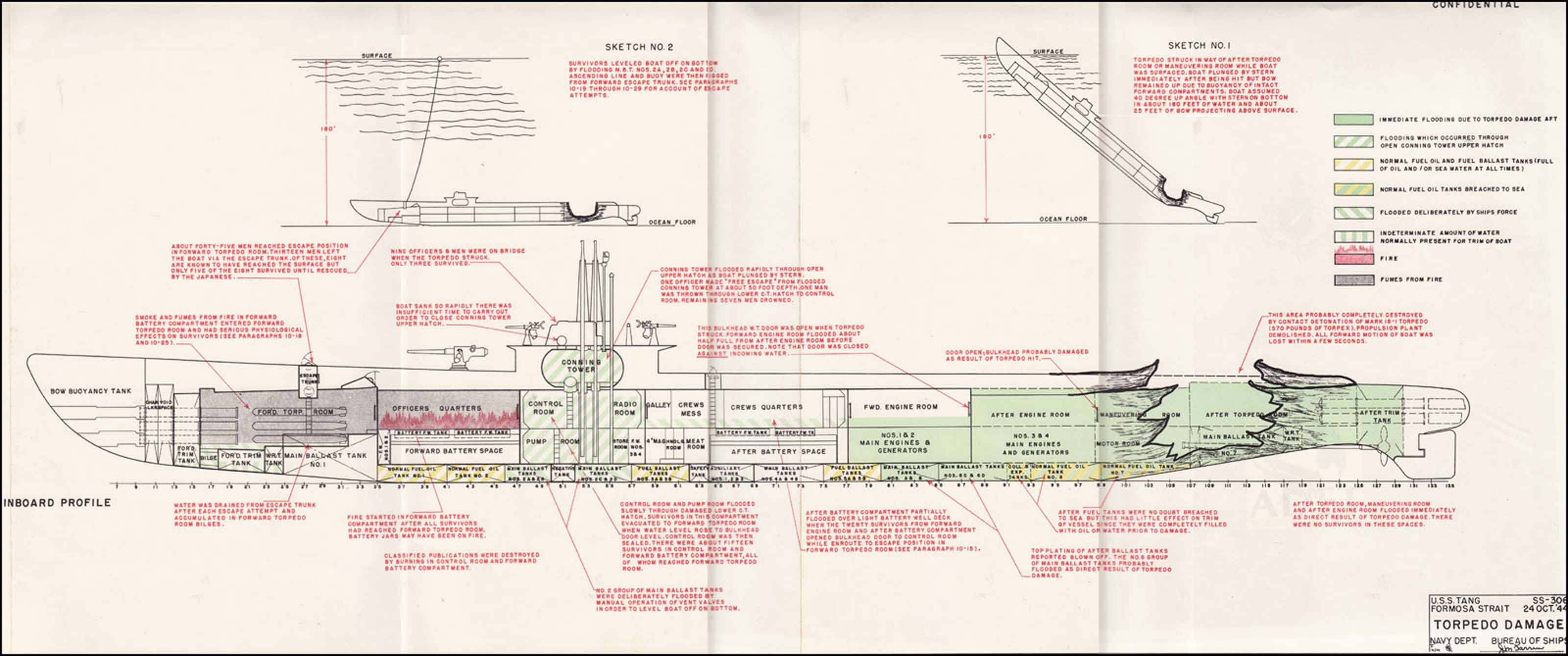
O’Kane ordered emergency maneuvers, and Tang fishtailed hard, trying to escape the path of her own weapon. Twenty seconds later, the torpedo slammed into her aft torpedo room.
The force of the explosion was brutal. Men as far forward as the control room were thrown and broke limbs. The stern quickly flooded, and the submarine dropped, tail-first, to the seafloor 180 feet below.
Of the nine men on the bridge topside—including O’Kane—only three survived the blast and were able to swim through the night until they were picked up eight hours later. One more escaped the flooded conning tower and joined them. The rest were trapped below.


The Fight Below
Inside the wreck, thirty survivors gathered in the forward torpedo room, intending to use the forward escape trunk. The submarine bottomed at 180 feet as the aft compartments flooded. Her crew burned sensitive materials, waiting for the right moment to escape.
But the fight was far from over.
A Japanese patrol dropped depth charges overhead, triggering an electrical fire in the forward battery. As the heat began to rise, paint on the bulkhead blistered, melted, and dripped.
At 6:00 a.m., the survivors began their escape, one by one. It would become the only recorded wartime use of the Momsen lung. Thirteen men made it out. Only five were rescued.
In the end, just nine men survived the sinking of USS Tang.
The War Continues
Seventy-eight souls were lost. Among them was Rubin MacNiel Raiford, possibly the youngest American to die in combat at just 15 years old.
When a Japanese frigate recovered the survivors, the Americans found themselves face to face with men who had survived Tang’s sinkings from the night before. Beaten and battered, O’Kane said, “When we realized that our clubbing and kickings were being administered by the burned, mutilated survivors of our handiwork, we found we could take it with less prejudice.”
The nine survivors were taken captive, placed in a prison camp at Ōfuna until the end of the war, where they were interrogated by Japanese intelligence. Tang remains on Eternal Patrol.

Reliable Thoughts: The Cost of Precision
USS Tang’s final patrol is remembered for its audacity. In five days, she sank more enemy tonnage than most submarines achieved in their entire war tours. Yet it ended not with a final enemy volley, but with the failure of a weapon designed by her own nation.
Captain Richard O’Kane was among the Navy’s best, and his crew reflected the same excellence. But no amount of bravery or brilliance could stop the mechanical flaw in a Mark 18 torpedo. Tang paid the price for that imperfection, sealing her legend in fire and silence.
War often rewards precision. But it also punishes it.
Tang’s story reminds us that even the best-prepared can suffer from the smallest failure—and that no amount of courage makes one invincible. Her loss wasn’t just a Navy tragedy, it was a lesson about human limits.
She lies silent beneath the waves now, but Tang was more than just a submarine. She was a symbol of precision—and the price it sometimes demands.


Leave a Reply