

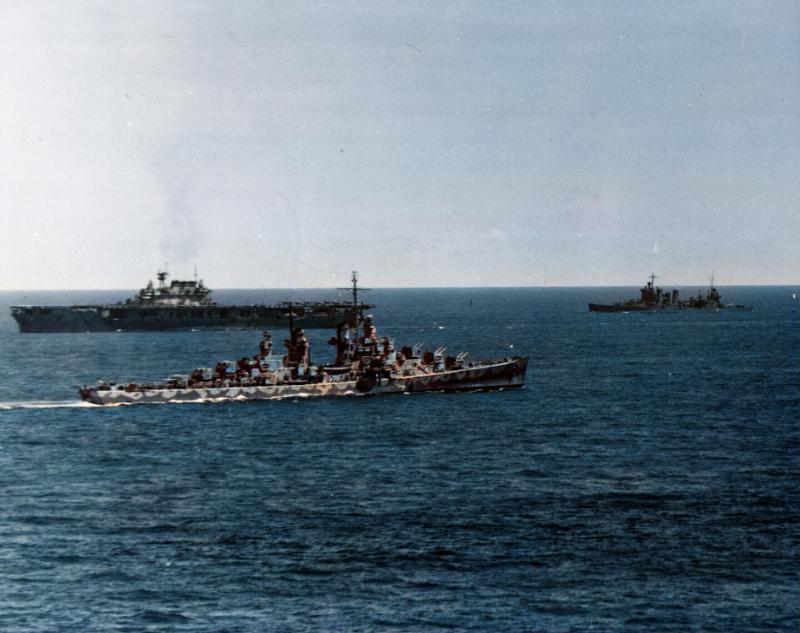
Discover the history of USS Atlanta (CL-51), the lead ship of the Atlanta-class cruisers that helped defend US fleets during World War II.
USS Atlanta (CL-51) was a light cruiser in the United States Navy and the first of the Atlanta-class ships. Named in honor of Atlanta, Georgia, she was designed to protect naval task forces with powerful anti-aircraft guns. She would play a role in major battles throughout the Pacific theater during World War II.
Often known as CLAA-51 because of her dual-purpose 5-inch guns, USS Atlanta could fire high-explosive, armor-piercing, and anti-aircraft shells. Although her armor was light compared to other cruisers, her long deck and impressive battery of sixteen 5-inch guns made her unique.
Atlanta-class ships were originally designed to command and support destroyers. Even after being reclassified as light cruisers, these ships kept many of their features, including rapid-firing, destroyer-caliber guns.
Learn more about the fascinating history of the USS Atlanta and check out more stories at The Reliable Narrator.
Construction of USS Atlanta
USS Atlanta was built to lead a new class of light cruisers. Her construction began on April 22, 1940, at Kearny, New Jersey, by the Federal Shipbuilding and Drydock Company. She was launched on September 6, 1941, and sponsored by Margaret Mitchell, the author of Gone with the Wind. The ship was commissioned on December 24, 1941, at the New York Navy Yard with Captain Samuel P. Jenkins in command.
Plot Points
Armament Overview
Atlanta was designed with a unique gun layout that reflected her role as an anti-aircraft cruiser.
| Component | Details |
| Main Guns | 16 × 5-inch (127 mm)/38 caliber Mark 12 guns arranged in 8 twin mounts. Configuration: 3 twin mounts forward, 3 twin mounts aft, plus 2 wing-mounted guns (one on each side). |
| Firing Arcs | The forward and aft batteries had intersecting arcs, allowing all guns to fire within a 60° broadside angle. |
| Anti-Aircraft | 16 × 1.1-inch (28 mm)/75 AA guns (grouped in 4 batteries of 4) and 8 × single 20 mm (0.79 in) Oerlikon AA cannons. |
| Torpedo Tubes | 8 × 21-inch (533 mm) torpedo tubes. |
Technical Specifications
The key technical details and performance statistics of the USS Atlanta:
| Parameter | Specification |
| Class and Type | Atlanta-class light cruiser |
| Displacement | Standard: 6,718 long tons (6,826 t) Maximum: 8,340 long tons (8,474 t) |
| Length | 541 ft 6 in (165.05 m) |
| Beam | 53 ft (16 m) |
| Draft | Mean: 20 ft 6 in (6.25 m) Maximum: 26 ft 6 in (8.08 m) |
| Installed Power | 75,000 shp (56,000 kW) from 4 steam boilers |
| Propulsion | 2 geared turbines, 2 screws |
| Speed | 32.5 knots (37.4 mph / 60.2 km/h) |
| Complement | 673 officers and enlisted personnel |
| Sensors and Radar | 2 FD fire control radars in Mk 37 directors 1 SC Air search radar (added in 1942) |
| Armor Protection | Belt: 1.1–3+3⁄4 in (28–95 mm) Deck: 1+1⁄4 in (32 mm) Turrets: 1+1⁄4 in (32 mm) Conning Tower: 2+1⁄2 in (64 mm) |


Service History of the Atlanta
USS Atlanta quickly proved her worth after fitting out and completing shakedown training. From March 1942, the new cruiser honed her skills in the Chesapeake Bay before returning to the New York Navy Yard for repairs and modifications. By March 31, 1942, she was deemed “ready for distant service.”
On April 5, the cruiser left New York for the Panama Canal Zone. After reaching Cristobal on April 8 and transiting the canal, she set a course for Clipperton Island to scout for enemy activity. With no threats found, she arrived at Pearl Harbor on April 23.
Battle of Midway
During her stay at Pearl Harbor, Atlanta participated in anti-aircraft exercises off Oahu. On May 10, she sailed with USS McCall as an escort for the USS Rainier and USS Kaskaskia heading to Nouméa, New Caledonia. Shortly after, on May 16, she joined Vice Admiral William Halsey’s Task Force 16, which was centered around the aircraft carriers Enterprise and Hornet. The task force was recalled to Hawaiian waters in response to an imminent Japanese threat toward Midway Atoll and arrived back at Pearl Harbor on May 26.
The following morning, Atlanta set sail once again with Task Force 16, and played a vital role screening the carriers as they patrolled northeast of Midway. On June 4, when reports of Japanese ships emerged from the southwest, Atlanta moved to support Hornet. That day, carrier planes from Yorktown and Enterprise struck four major Japanese aircraft carriers. USS Atlanta provided relentless protection as Japanese planes attacked Task Force 17.
Returning to Pearl Harbor on June 13, Atlanta conducted further anti-aircraft practice. On July 15, the cruiser sailed with Task Force 16 once more for Tongatapu. By July 29, with preparations underway for the Guadalcanal invasion, the cruiser was assigned to Task Force 61. During the initial landings on August 7–8, she played a key role screening carriers. Atlanta continued to operate near the Solomon Islands until August 9, when the carrier task forces withdrew.
Battle of the Eastern Solomons
On the morning of August 23, American scout planes spotted Admiral Isoroku Yamamoto’s Combined Fleet moving south towards Guadalcanal. Enterprise and Saratoga launched planes, but deteriorating weather and the Japanese reversing course resulted in no contact being made.
On August 24, USS Atlanta received multiple enemy contact reports while screening Enterprise. At 13:28, an enemy “snooper” was sighted, sending her crew to general quarters. By 15:30, Task Force 16 moved north-northwest to close in on the reported enemy carrier group.
As enemy planes from the Japanese carriers Shōkaku and Zuikaku began their attack, the task force was forced to increase speed to 27 knots. Around 17:10, the Japanese raid—estimated to include at least 18 Aichi D3A1 “Val” dive bombers—approached from the north. Over the next 11 minutes, Atlanta poured a barrage of fire over Enterprise as the carrier took evasive maneuvers. Despite heavy anti-aircraft fire, Enterprise sustained a hit with minor damage. USS Atlanta may have shot down as many as five enemy aircraft and was not damaged during this engagement.
Aftermath
The following day, USS Atlanta was reassigned to Task Force 11, which was redesignated as Task Force 61 on August 30. On August 31, the submarine I-26 torpedoed the carrier Saratoga. Atlanta quickly moved to screen the damaged flagship while USS Minneapolis rigged a towline to assist with recovery. The force then put into Tongatapu on September 6, where Atlanta received provisions, fuel, and underwent routine upkeep.
From September 13 onward, USS Atlanta continued her escort duties. After refueling and taking on stores and ammunition, the cruiser sailed on September 21 as part of Task Group 66.4. By September 23, she became part of Task Force 17 before being detached the next day to proceed with USS Washington, Walke, and Benham to Tongatapu.
On October 23, following a failed Japanese offensive to dislodge the Americans from Guadalcanal, Admiral Yamamoto ordered the Combined Fleet south to try to destroy the American fleet. Operating alongside Washington, San Francisco, Helena, and two destroyers, USS Atlanta played a supporting role during the Battle of the Santa Cruz Islands on October 26.
On the morning of October 28, Atlanta took on Rear Admiral Norman Scott from San Francisco and became the flagship of the newly designated Task Group 64.2. Arriving off Lunga Point on the morning of October 30, Atlanta embarked Marine liaison officers at 05:50 and began bombarding Point Cruz at 06:29 while destroyers formed a protective column behind her. With no return fire from the enemy, Task Group 64.2 completed its mission and returned to Lunga Point.
Naval Battle of Guadalcanal
During the intense fighting at Guadalcanal, USS Atlanta served as Admiral Scott’s flagship. Along with four destroyers, she escorted supply ships—Zeilin, Libra, and Betelgeuse—to Guadalcanal. The ships of Task Group 62.4 stayed off Lunga Point, unloading supplies and disembarking troops.
On the morning of November 12, the task group received word that enemy aircraft were on their way. By 09:20, Atlanta led three auxiliary ships north, with the destroyers forming a protective circle around them. Fifteen minutes later, nine Japanese Aichi D3A1 “Val” dive bombers appeared. The American ships quickly opened fire, shooting down several planes, with the supply ships only suffering minor damage. Soon after, another air raid began. This time, 27 Mitsubishi G4M “Betty” bombers approached in a loose V formation from over Cape Esperance. Despite the destroyers opening fire, the planes stayed out of range and continued on to bomb Henderson Field.
As night fell, a new threat emerged. A Japanese surface force, which included two battleships, one cruiser, and six destroyers, was detected moving toward Guadalcanal. To protect the transport ships, Admiral Daniel Callaghan ordered Task Group 67.4 to leave Lunga Point and cover the retreat.
An hour before midnight, Callaghan’s ships turned west. Helena’s radar first picked up enemy contacts at a range of 26,000 yards. However, a sudden course change ordered by Admiral Callaghan forced Atlanta to turn to port quickly to avoid colliding with one of the destroyers. As she moved to regain her position ahead of the cruiser San Francisco, she was illuminated by the Japanese destroyer Akatsuki. Shifting her main battery, USS Atlanta opened fire on Akatsuki at about 1,600 yards. Targeting the enemy’s searchlights, Akatsuki was soon overwhelmed by the combined firepower of the American ships.
At the same time, two other Japanese destroyers crossed Atlanta’s path. She engaged them with her forward 5-inch guns, while her aft guns kept firing at the Akatsuki. Then, a torpedo struck the cruiser’s forward engine room on her port side. This torpedo, likely fired by either Inazuma or Ikazuchi, the destroyers supporting Akatsuki, caused Atlanta to lose nearly all power and forced her to shift steering control to the aft engine room.
The Sinking of USS Atlanta
After the torpedo strike, the chaos worsened. In the confusion of battle, USS Atlanta was hit by an estimated 19 eight-inch shells fired by the cruiser USS San Francisco. Most of the shells passed through without exploding, but shrapnel caused severe damage, killing many of Atlanta’s crew, along with Admiral Scott and several members of his staff.
Atlanta prepared to return fire on her new assailant, but San Francisco’s gun flashes illuminated her “non-Japanese hull profile,” and the effort was suspended. It is believed that San Francisco’s shells, which passed high through Atlanta’s superstructure, may have been intended for an enemy target further beyond.
Atlanta’s Captain Samuel Jenkins, stuffing a minor foot wound, assumed command of the cruiser. His ship was badly battered, largely powerless, down by the head and listing slightly to port, and a third of his crew was dead or missing. As the battle continued, her men began clearing debris, jettisoning topside weight to correct the list, and aiding the wounded.
By daylight, three burning American destroyers, the disabled USS Portland, and the abandoned hulk of Yūdachi were seen nearby. Drifting toward the enemy-held shore east of Cape Esperance, Atlanta dropped her starboard anchor. Wounded crewmen were taken off by boats from Guadalcanal, and by mid-morning, the most severely injured had been evacuated.
At 09:30 on November 13, the minesweeper Bobolink arrived to tow the crippled cruiser to safety. During the tow, she managed to drive off a “Betty” bomber with one of her surviving 5-inch mounts. Reaching Kukum around 14:00, Captain Jenkins met with his remaining officers. Realizing that the damage was too severe and that the cruiser was taking on too much water, he concluded that saving the ship was impossible. After the remaining crew members—save Jenkins and a small demolition party—escaped, an explosive charge was detonated.
At 20:15 on November 13, 1942, USS Atlanta sank 3 nautical miles west of Lunga Point in approximately 400 feet of water. Her name was officially removed from the Naval Vessel Register on January 13, 1943. In her final battle, 170 crew members lost their lives and 103 were wounded.
Reliable Thoughts – A Lesson from the Past
The story of the USS Atlanta is one of determination and sacrifice. This remarkable light cruiser played a vital role in some of the most important battles of World War II—from the Battle of Midway to the fierce engagements at the Eastern Solomons and Guadalcanal.
Atlanta’s powerful armament and agile manuverability helped protect American carriers and support ground forces throughout the Pacific Theater. Her loss in the Naval Battle of Guadalcanal serves as a lasting tribute to the courage of the men of her crew.


Leave a Reply