

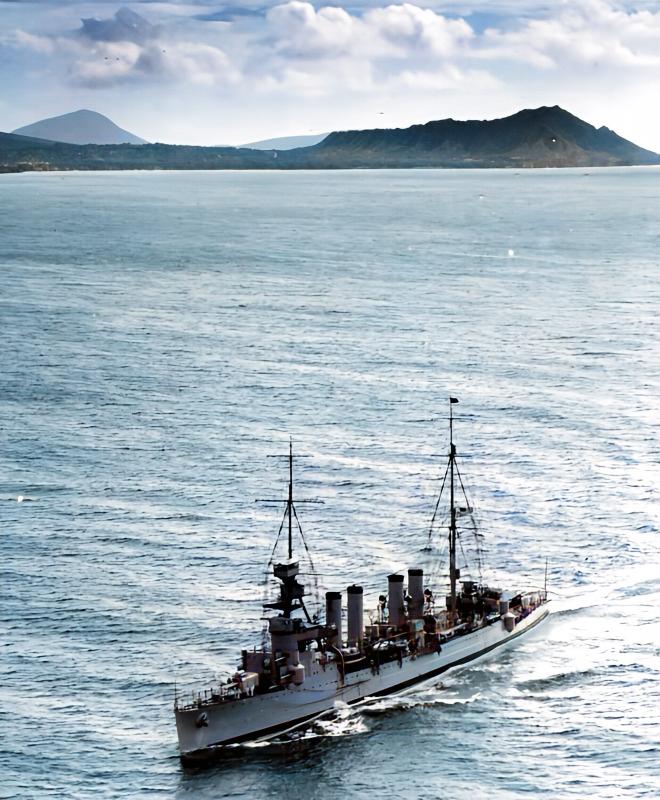
From World War I innovations to World War II stalwarts, Omaha-class cruisers exemplified resilience in the face of global conflict.
As the United States plunged into World War II, the Navy called upon the Omaha-class cruisers—seasoned vessels that had been the epitome of naval innovation following World War I. Despite their age, these ships transitioned from their original roles to become indispensable assets in various theaters of the war. Their journey from cutting-edge designs to reliable workhorses underscores a story of resilience and adaptability, reflecting the Navy’s evolution during a time of unprecedented global conflict.
Learn more about the history of the Omaha-class cruisers and more naval history at The Reliable Narrator.
Plot Points
Design and Development
Omaha-class cruisers were conceived during a transformative period in naval warfare, reflecting both innovative aspirations and lingering traditions. Authorized under the ambitious 1916 naval shipbuilding program, these cruisers were designed to fulfill the role of fleet scouts, a necessity underscored by the US Atlantic Fleet’s deficiency in fast reconnaissance vessels. The primary objective was to create ships capable of high-speed operations—up to 35 knots—to effectively scout for battleship fleets, collaborate with destroyers, and counter enemy destroyers.
The design of the Omaha class drew direct inspiration from the British Centaur subclass of the Royal Navy’s C-class cruisers. At the time, US Navy planners considered the Royal Navy a potential rival, leading to design considerations that mirrored British advancements. This perspective influenced the Omaha class’s emphasis on speed and armament, aiming to match or surpass potential adversaries.
Visually, the Omaha-class cruisers bore a striking resemblance to the Clemson-class destroyers, characterized by their four smokestacks and flush-deck design. This similarity was so pronounced that a camouflage scheme was developed to enhance the resemblance.
Armament-wise, the ships featured a combination of turret-mounted and casemate-mounted guns, a shift from traditional broadside arrangements to more modern turret configurations. They were among the last cruisers worldwide to incorporate broadside-mounted weaponry, marking the end of an era in naval architecture.

Service Modifications and Design Flaws
Throughout their service, Omaha-class cruisers underwent several modifications to address design shortcomings and the evolving needs of naval warfare. Initially equipped with mine-laying capabilities, these features were removed in 1926 due to operational impracticalities.
Anti-aircraft armament was progressively enhanced, reflecting the increasing threat from the skies. The original 3-inch AA guns were increased from two to eight, all mounted in the ship’s waist. Additionally, the lower torpedo tube mounts were removed and plated over before the start of World War II.
Despite these updates, limitations of the Omaha design became more pronounced over time. The ships were insufficiently insulated, leading to uncomfortable conditions in both tropical and arctic climates. The low freeboard resulted in frequent water ingestion over the bow and into the torpedo compartments and lower aft casemates. Additionally, the lightly-built hulls were prone to leaking, and sustained high-speed steaming could lead to contamination of oil tanks with seawater. Omaha-class cruisers also faced a serious design flaw with a complete lack of watertight bulkheads anywhere above the main deck or aft on the main deck.
Despite the drawbacks, the Omahas featured several innovative features. They were the first US cruisers designed after the switch from coal to oil-fired boiler, and were better compartmentalized, with propulsion machinery laid out to prevent immobilization by a single torpedo strike. These ships were also the first to have their magazines placed on the centerline, below the waterline.

Operational Role and Legacy
Originally envisioned as fleet scouts, Omaha-class cruisers evolved due to advancements in naval technology. Throughout the interwar period, they primarily served as leaders of destroyer flotillas, leveraging their speed and firepower to protect larger fleet units from enemy destroyer attacks. The advent of cruiser-based aircraft and the development of heavy cruisers for long-range scouting diminished the class’s initial reconnaissance role. Nevertheless, their high speed and firepower ensured their continued utility in fleet screening and support roles.
By the onset of World War II, the Omaha-class cruisers were among the oldest active vessels in the US Navy. Their continued service during the war, despite design limitations and the rapid advancement of naval technology, stands as a testament to their robust construction and the adaptability of their crews. The Omaha class’s journey from cutting-edge scouts to venerable fleet workhorses encapsulates a dynamic period in naval history, reflecting the rapid evolution of maritime warfare and ship design in the first half of the 20th century.
Omaha-Class Alternatives and Evolution
Omaha-class cruisers were part of a broader design exploration aimed at creating versatile naval assets. Two alternative designs were considered alongside the Omahas.
The first was a monitor-type vessel armed with two 14-inch guns mounted in two single turrets. This design was intended for shore bombardment and heavy fire support, but it was ultimately abandoned in favor of a more balanced scout cruiser.
The second alternative was armed with four 8-inch guns in two twin turrets. This design prioritized heavier firepower over agility. It eventually evolved into the Pensacola-class cruiser, the first US heavy cruiser built under the terms of the Washington Naval Treaty. The Pensacola class retained Omaha’s emphasis on speed but incorporated heavier guns and improved armor, setting the standard for future heavy cruiser designs.
In 1928, after the successful commissioning of the aircraft carrier USS Langley (CV-1), the Navy explored the idea of an Omaha-class conversion into a light carrier. This proposed carrier alternative would have removed the two twin 6-inch/53 caliber gun turrets, leaving only four single 6-inch/53 caliber guns. However, the design was not pursued, as larger carriers with more substantial air groups were seen as more strategically valuable.

World War II Service
The Omaha-class cruisers, though aging by the onset of World War II, played a critical role in the early stages of the conflict. USS Detroit (CL-8) and USS Raleigh (CL-7) were both present at Pearl Harbor during the Japanese surprise attack on December 7, 1941. Raleigh was torpedoed and heavily damaged, but Detroit escaped the harbor alongside the cruisers St. Louis and Phoenix, one of the few large ships to successfully evade damage during the attack.
Due to their age and design limitations, Omaha-class cruisers were generally assigned to secondary theaters and less demanding roles during the war. Their combination of speed and armament made them well-suited for patrol and escort duties where major naval opposition was unlikely.
The class saw action in several key theaters:
- South America – Patrolling the east and west coasts to deter Axis naval activity and protect Allied shipping.
- South Pacific – Escorting convoys and conducting long-range patrols far from the front lines.
- Aleutians and Kuril Islands – Engaging in shore bombardment and patrol operations in the cold, isolated waters of the North Pacific.
- Invasion of Southern France (1944) – Providing fire support during Operation Dragoon, where naval resistance was expected to be light.
Several Omaha-class cruisers saw direct combat during the war:
- USS Marblehead (CL-12) participated in early Pacific operations, including the Battle of Makassar Strait in February 1942, where she suffered severe bomb damage but managed to escape and undergo repairs.
- USS Richmond (CL-9) engaged in the Battle of the Komandorski Islands in March 1943, helping to repel a Japanese convoy attempting to reinforce the Aleutian garrison.
- USS Detroit (CL-8) had one of the most active wartime careers in the class. She served as the flagship of the Logistics Support Group (TF 50.8), supporting the Battle of Iwo Jima and the Invasion of Okinawa in 1945.
Remarkably, none of the Omaha-class cruisers were lost to enemy action during the war. Aside from Raleigh’s torpedo damage at Pearl Harbor and Marblehead’s damage at Makassar Strait, the class avoided serious combat losses.
As the war ended, the Omaha-class cruisers were considered obsolete compared to newer designs. Most were decommissioned and scrapped within seven months of Japan’s surrender in September 1945.
- USS Milwaukee (CL-5) was an exception—she had been loaned to the Soviet Navy in 1944 as Murmansk under the Lend-Lease program. Milwaukee was returned to the US Navy in 1949 and promptly scrapped, closing the chapter on the Omaha class’s long and varied service history.
Reliable Thoughts – Great War Forerunners
Omaha-class cruisers bridged the gap between the pre-World War I scout cruisers and the modern heavy and light cruisers of World War II. Their emphasis on speed, scouting ability, and a balanced armament influenced the design of later cruiser classes, including the Pensacola-class heavy cruisers.
The Omaha class demonstrated the value of fast, versatile cruisers capable of both reconnaissance and combat support, setting the foundation for the more heavily armed and armored cruisers that would dominate naval warfare in the decades to come.


Leave a Reply