

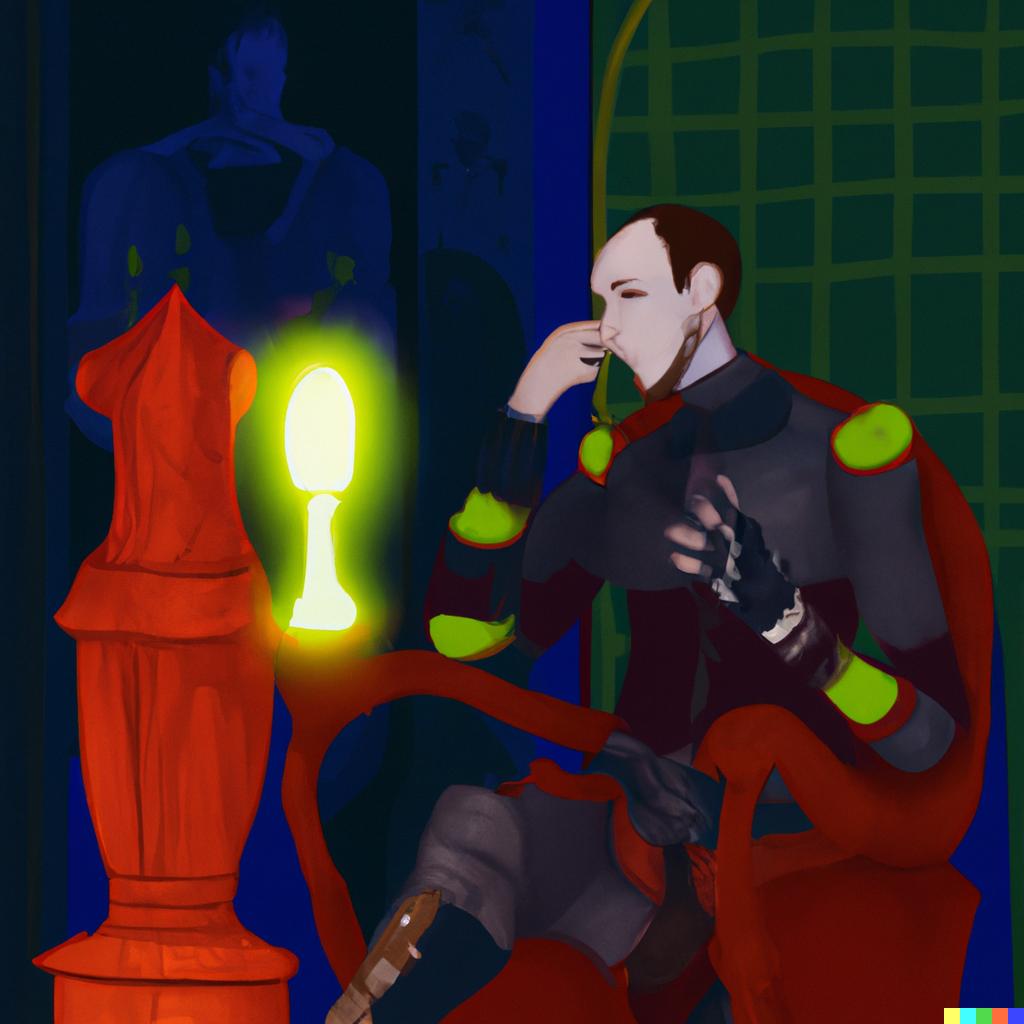
The arrival of AI has many people fearful about its impact on the future. While some worry this advanced technology will replace human professions, many are beginning to explore the limitless potential of a new tool. From researching quantum physics to bringing William Shakespeare’s Macbeth off the page, ChatGPT is a beacon of possibility.
Thanks to innovations in technology, it is possible to converse with literary characters like Macbeth. ChatGPT can create an AI persona and help readers gain a clearer and deeper understanding of their story.

Table of Contents
An Interview with Macbeth
Giving ChatGPT a set of instructions allows it to take on the character of Macbeth. This AI-persona is the ideal guide to help us navigate William Shakespeare.
The result is an informative interview that explores the interworkings of the play. As a character, Macbeth is a pitiable man corrupted by the pursuit of power. As an AI persona, he is extremely clear-headed and provides answers with laser-focused insight.
With the right prompts, ChatGPT can walk students through the Tragedy of Macbeth and help them explore one of Shakespeare’s classics.
Introduction to William Shakespeare’s Macbeth
The Reliable Narrator’s ChatGPT interviews begin by asking establishing questions. This helps ensure the AI has understood its instructions and is providing information from the correct material.
The developers of ChatGPT warn that the AI’s responses may return incorrect information. AI Macbeth does seem to provide accurate details about the play. It also responds in easy-to-understand language- something more reluctant Shakespeare readers may be relieved to hear.
The interview begins below:
The Reliable Narrator:
Thank you for taking the time to speak with us. Could you introduce yourself to the audience?
Macbeth:
Of course, I’d be happy to introduce myself. I am Macbeth, Thane of Glamis, and later, Thane of Cawdor. I am a Scottish nobleman who becomes consumed by ambition and a desire for power after encountering three witches who prophesize that I will become king. My story is a tragic one, filled with guilt, betrayal, and ultimately, my own downfall.
The Reliable Narrator:
How does the tragedy of Macbeth begin?
Macbeth:
The tragedy of Macbeth begins with my return from a successful battle for King Duncan of Scotland against a rebel army led by Macdonwald. Along with my comrade Banquo, we encounter three witches who make three prophesies. The witches hail me as Thane of Glamis, Thane of Cawdor, and future king, and they also tell Banquo that his descendants will be kings. This prophecy begins to consume my thoughts, and I become increasingly ambitious and power-hungry, leading to a tragic sequence of events.
The Reliable Narrator:
Why would you listen to these witches, Macbeth? You were Thane of Glamis, not Cawdor. And you were not the King.
Macbeth:
Indeed, you raise a valid point. At first, I was skeptical of the witches’ prophesies, as they seemed too fantastical to be true. However, when Ross and Angus arrive to inform me that I have been appointed the new Thane of Cawdor, I begin to believe that the witches’ prophesy might be coming true. This news fuels my ambition and leads me to contemplate what I would need to do in order to become king, even though it goes against my loyalty to King Duncan. In essence, my desire for power and the possibility of becoming king overrides my better judgement, leading me down a path of tragedy and self-destruction.
The Reliable Narrator:
And what would you need to do to become King at this point, Macbeth?
Macbeth:
To become king, I believed that I would need to eliminate the current king, Duncan, who was a kind and well-respected leader. My ambition and the witches’ prophesy made me contemplate this course of action, and I ultimately made the fateful decision to murder Duncan in his sleep. I saw this as a means to an end, a way to fulfill my ambition and achieve my ultimate goal of becoming king. However, as events unfolded, my actions led to my own downfall, as guilt, paranoia, and betrayal consumed me, ultimately leading to my tragic end.
Unchecked Ambition and Regicide
Interestingly, ChatGPT needed to be prompted to bring up Lady Macbeth. Similar to her husband, she is a highly ambitious and manipulative character that plays an instrumental role in the rising action of the play.
In many of Shakespeare’s plays, women play important and controversial roles. They are often portrayed as powerful and intelligent, but also as manipulative and conniving. Lady Macbeth is no exception.
Lady Macbeth is a complex and compelling character in Shakespeare’s play, determined to help her husband become king, even if it means committing murder. ChatGPT discusses her character below:

The Reliable Narrator:
Have No Fear, Macbeth. This decision was not yours alone. Did Lady Macbeth offer you advice on this grim endeavor?
Macbeth:
Yes, you are correct. Lady Macbeth played a significant role in persuading me to commit the murder of King Duncan. She was ambitious as I was, and she saw the opportunity for us to gain power and wealth as a result of my becoming king. Lady Macbeth was instrumental in encouraging me to carry out the murder, even going so far as to insult my masculinity and courage in order to spur me on. Her influence over me and my own ambition ultimately led to the tragic decision to take Duncan’s life.
The Reliable Narrator:
How did you murder King Duncan? That is a hard thing to live with. More importantly, how did you get away with it and succeed Duncan?
Macbeth:
The murder of King Duncan was a difficult and tragic act that I will carry with me for the rest of my days. I killed him while he was sleeping in his chamber, using a dagger that I had brought with me for that purpose. It was a brutal and ruthless act, one that I believed was necessary to fulfill the witches’ prophesy and to achieve my ambition of becoming king.
As for getting away with the murder, I was able to frame the king’s chamberlains for the crime by planting the murder weapon and smearing their faces with blood. Lady Macbeth and I also put on a convincing show of grief and outrage over the king’s death, which helped to deflect suspicion away from us. These actions allowed me to succeed Duncan as king, but my guilt and paranoia began to consume me, leading to a series of events that ultimately led to my downfall.
Prophecies and Fate in Shakespeare
Prophecy and fate play a significant role in a number of Shakespeare’s plays. The Tragedy of Macbeth follows the same pattern. The character’s downfall begins with the witches’ prophecy.
These predictions serve as a catalyst for Macbeth’s ambition and lead him to commit heinous acts to fulfill his destiny. The play explores the themes of free will versus fate and the consequences of trying to manipulate or resist one’s destiny.
The use of prophecy and fate is a common element in Shakespeare’s plays and serves to highlight the uncertainty of life. AI Macbeth reflects on these themes in the next section of our interview.

The Reliable Narrator:
I can imagine you would be very paranoid. Was Lady Macbeth feeling guilt as well? And what did your friend Banquo think after seeing these prophecies fulfilled?
Macbeth:
Lady Macbeth did begin to feel guilt and remorse over our actions, particularly as we began to suffer the consequences of our actions. Her mental state began to deteriorate, and she eventually succumbed to madness before ultimately taking her own life. The guilt and shame of our actions ultimately became too much for her to bear.
As for Banquo, he was suspicious of my actions after witnessing the witches’ prophesy come true, and he became a threat to my reign as king. I feared that he would challenge my claim to the throne, so I ordered his murder as well. This was a grave mistake, as it ultimately led to my downfall. Banquo’s ghost began to haunt me, and his murder alienated me from some of my closest allies. The witches’ prophesy also came true in a twisted way, as Banquo’s descendants eventually did become kings, causing me to feel even more guilt and remorse over my actions.
The Reliable Narrator:
You killed Banquo? How? The witches’ prophecy is a twisted irony. Did you seek their guidance further, Macbeth?
Macbeth:
Yes, I ordered Banquo’s murder as I saw him as a threat to my reign as king. I hired murderers to carry out the deed, and they ambushed Banquo and his son Fleance, killing Banquo but failing to kill Fleance. This led to my own downfall as Fleance’s escape meant that there was a potential threat to my rule that I had failed to eliminate.
As for the witches’ prophecy, their twisted irony is something that I will never forget. While their prophesies initially gave me hope and fueled my ambition, they ultimately led to my own destruction. Despite this, I did seek their guidance once more when I visited them before my final battle, hoping to hear something that might give me an advantage. However, their words only served to further confuse and unsettle me, and ultimately, they did not provide me with any meaningful help or guidance.
The Reliable Narrator:
Have No Fear, Macbeth. Let’s take a look at their second prophecy. What were the witches’ words?
Macbeth:
The witches’ second prophecy was that “none of woman born shall harm Macbeth” and that “Macbeth shall never vanquish’d be until Great Birnam Wood to high Dunsinane Hill shall come against him.” These prophesies initially gave me confidence, as I believed that they meant I was invincible and that my reign as king was secure. However, these words were ultimately my downfall, as they were interpreted in ways that I did not expect.
The Reliable Narrator:
Correct me if I am wrong, good sir, but I see this as a very favorable prophecy. “None of woman born shall harm Macbeth” implies you are invincible. Every human is born from a woman. And you will never be vanquished until a forest comes against you? This is not Lord of the Rings, trees cannot march against you.
Macbeth:
You are correct in that these prophesies initially appeared favorable to me, and I interpreted them as such. The idea that none of woman born could harm me gave me a false sense of security, as I believed that this meant I was invincible. Similarly, the idea that I would never be vanquished until a forest came against me seemed impossible, as I did not believe that a forest could move.
However, these prophesies were ultimately my downfall, as they were interpreted in unexpected ways. For example, Macduff, who was “not of woman born” as he was born via Caesarean section, was ultimately the one who defeated me. Similarly, the soldiers who attacked me carried branches from Birnam Wood, which they used to disguise their approach and ultimately fulfill the prophesy that “Birnam Wood to high Dunsinane Hill shall come against” me. So, while these prophesies initially seemed favorable, they ultimately led to my demise.
The Reliable Narrator:
Why was being born via Caesarean section considered “not of woman born”?
Macbeth:
In the context of the play, being born via Caesarean section was considered “not of woman born” because the procedure involved the extraction of the baby from the mother’s womb, rather than through the natural process of childbirth. Therefore, Macduff’s birth was seen as separate from the typical process of birth and, as such, was considered to fulfill the witches’ prophecy that “none of woman born shall harm Macbeth.” It’s important to note that this interpretation of the prophecy is specific to the play and is not necessarily accurate in real life.
The Reliable Narrator:
Of course- I was merely looking for some historical context for that idea.
Macbeth:
Understood. In historical context, the idea that a child born via Caesarean section was not “of woman born” was a belief that dated back to ancient times. In many cultures, including ancient Rome, it was believed that a child born via Caesarean section was not truly born in the same way as a child born naturally and therefore did not have the same status or legitimacy. This belief persisted for many centuries, and it is possible that Shakespeare drew upon this belief when crafting the prophecy in Macbeth. However, it’s important to note that the historical context of this belief is complex and varied, and there is no single definitive explanation for why being born via Caesarean section was considered different from a natural birth.
The End of Macbeth
Act 5 of Shakespeare’s Macbeth sees the events of the play come to a tragic conclusion.
The character Macbeth has become a tyrant, his reign is marked by bloodshed and paranoia. Here he faces his inevitable downfall, as Macduff’s army marches on him.
Macbeth ultimately faces Macduff in a dramatic final battle, leading to the titular character’s death. The play concludes with the Malcolm becoming the rightful king of Scotland. ChatGPT reflects on the conclusion here.
The Reliable Narrator:
How were you feeling in the final Act 5, Macbeth? You mentioned your wife’s suicide- I am terribly sorry to hear this. How were you feeling? What were you doing?
Macbeth:
In Act 5, I was in a state of despair and hopelessness. I was wracked with guilt and grief over the murders I had committed, and my mental state was further aggravated by the news of Lady Macbeth’s suicide. At this point in the play, I had lost all sense of purpose and was resigned to my fate, which I believed was inevitable.
In Act 5, Scene 5, I delivered the soliloquy beginning with the famous lines, “Tomorrow and tomorrow and tomorrow, / Creeps in this petty pace from day to day.” This soliloquy expresses my sense of futility and despair, as I reflect on the meaningless and fleeting nature of life. I was essentially waiting for my inevitable demise, and there was nothing I could do to change my fate.
In the final scenes of the play, I am eventually killed by Macduff, fulfilling the witches’ prophesy. Ultimately, I died a tragic and pitiable figure, consumed by my own ambition and guilt.
The Reliable Narrator:
What did you believe your fate was? When did you realize Macduff was “not of woman born”?
Macbeth:
I believed my fate was sealed from the moment I heard the witches’ prophecy that no man born of a woman could harm me. I took this prophecy to mean that I was invincible and could not be defeated by any mortal man.
However, my sense of security was shattered when I learned that Macduff, the man who eventually killed me, was born via Caesarean section. It was only at this moment, when I realized that Macduff was “not of woman born,” that I realized the true extent of my tragic error in placing my faith in the witches’ prophecies.
The moment of realization is depicted in Act 5, Scene 8, when I say, “And be these juggling fiends no more believed, / That palter with us in a double sense; / That keep the word of promise to our ear, / And break it to our hope.” In this moment, I finally recognized that the witches had deceived me with their prophecies and that my fate was no longer in my control.
The Reliable Narrator:
Who is Macduff? What did you two say during your final encounter? Did you resign or did you fight?
Macbeth:
Macduff is a Scottish nobleman and one of my chief opponents in the play. He is a loyalist to the rightful king, Duncan, and opposes my tyrannical rule.
During our final encounter, which takes place in Act 5, Scene 8, Macduff challenges me to a duel. I initially refuse to fight him, but then I am goaded into it by Macduff’s taunts and insults. In the end, we fight, but I am defeated and killed by Macduff.
During the fight, Macduff reveals that he was “untimely ripped” from his mother’s womb, meaning that he was born via Caesarean section and therefore not “of woman born,” which fulfills the witches’ prophecy. Despite this revelation, I refuse to back down and fight to the death.
Our final encounter is depicted in Act 5, Scene 8, where I say, “I will not yield, / To kiss the ground before young Malcolm’s feet, / And to be baited with the rabble’s curse.” In this moment, I am still consumed by my own pride and ambition, and I refuse to submit to my fate or admit my wrongdoing.
The Reliable Narrator:
Why did you let him taunt you into a fight knowing he would kill you?
Macbeth:
At that point in the play, I had lost everything that was important to me – my wife had died, my kingdom had crumbled, and my own guilt had consumed me. I was a broken man, filled with despair and desperation.
When Macduff challenged me to a fight, I initially refused, knowing that I could not win. But then I was goaded into it by Macduff’s insults, and I became filled with rage and a desire for revenge. In that moment, I was willing to risk everything, even my own life, in order to strike back at my enemy.
Looking back, I can see that my decision to fight Macduff was a mistake, driven by my own pride and my unwillingness to admit defeat. But in that moment, I was consumed by my own emotions and my desire for one final act of defiance.
The Main Point of Macbeth According to ChatGPT
The tragedy of Macbeth is a cautionary tale about paranoia, the dangers of unchecked ambition, and the destructive nature of power. The play also explores the theme of fate versus free will, as the character’s actions are influenced by the prophecies he receives, but ultimately he is held accountable for his choices.
ChatGPT Macbeth highlights the following takeaways:
The Reliable Narrator:
What are the lessons to be learned, Macbeth? Is there a moral or messages to take away from this tragic William Shakespeare play?
Macbeth:
There are many possible lessons to be learned from the play Macbeth, and different people may take away different messages depending on their own interpretation of the story. However, some of the most common themes and messages include:
The corrupting influence of power: Macbeth’s ambition and desire for power ultimately lead him down a path of destruction, causing him to lose everything that was important to him.
The dangers of unchecked ambition: Macbeth’s obsession with power and his willingness to do anything to achieve it ultimately lead to his downfall, demonstrating the dangers of unchecked ambition.
The consequences of moral wrongdoing: Macbeth’s guilty conscience and the punishment he ultimately receives for his crimes serve as a reminder of the consequences of moral wrongdoing.
The power of fate and prophecy: The witches’ prophecies drive much of the action of the play, suggesting that fate and destiny may play a powerful role in shaping our lives.
The importance of loyalty and honor: Characters like Macduff and Banquo demonstrate the importance of loyalty and honor, even in the face of great adversity.
Overall, Macbeth is a cautionary tale that warns against the dangers of ambition and the corrupting influence of power. It is a powerful reminder of the consequences of our actions and the importance of staying true to our values, even in the face of great temptation.
ChatGPT Macbeth Answers the Internet’s Questions
The Reliable Narrator took the opportunity to ask AI Macbeth some of the internet’s most asked questions about Shakespeare’s play. In a lightning round, ChatGPT answered some of the most popular searches.
What is the story of Macbeth about?
The story of Macbeth is a tragedy written by William Shakespeare, which tells the tale of a Scottish general named Macbeth, who receives a prophecy from three witches that he will become the King of Scotland. Encouraged by his ambitious wife, Lady Macbeth, he murders King Duncan and ascends to the throne. However, he becomes increasingly paranoid and tyrannical, leading to his eventual downfall and death.
What is the main point of this play?
The main point of Macbeth is the corrupting influence of power and ambition, and the tragic consequences that can result from unchecked ambition. It also explores the themes of fate, free will, and the supernatural.
Why is this play a tragedy?
Macbeth is considered a tragedy because it follows the classical tragic form of a noble character’s downfall due to a tragic flaw, or hamartia, in their character. Macbeth’s downfall is caused by his unchecked ambition, which leads to his moral corruption and eventual demise.
Why is the story of Macbeth so important?
The story of Macbeth is important because it is a timeless exploration of the human condition, delving into the themes of ambition, power, guilt, and the corrupting nature of unchecked desire. It also showcases Shakespeare’s mastery of language and storytelling.
What is irony in Macbeth?
Irony is a literary technique used in Macbeth, such as the situational irony of Macbeth becoming King by murdering the previous King, and the dramatic irony of Macbeth’s belief in his invincibility due to the witches’ prophecies being ultimately proved false.
What is the moral purpose behind the play Macbeth?
The moral purpose behind the play Macbeth is to warn against the dangers of unchecked ambition and the pursuit of power at any cost, and to illustrate the corrupting influence of greed and desire. It serves as a cautionary tale, reminding us that the pursuit of personal gain can have devastating consequences for ourselves and others.
What do the witches symbolize in the play Macbeth?
In the play Macbeth, the witches are often seen as a symbol of temptation and the corrupting influence of power. They represent the supernatural, and their prophecies are a driving force behind Macbeth’s descent into darkness. They also represent the idea that fate and destiny are not fixed, but rather malleable and subject to manipulation.
The witches’ ambiguous nature, with their prophesies that are simultaneously true and deceptive, reflects the idea that the pursuit of power can be a slippery slope, and that the pursuit of personal ambition can have grave consequences. Ultimately, the witches symbolize the destructive nature of unchecked ambition and the corrupting influence of power.


Leave a Reply