

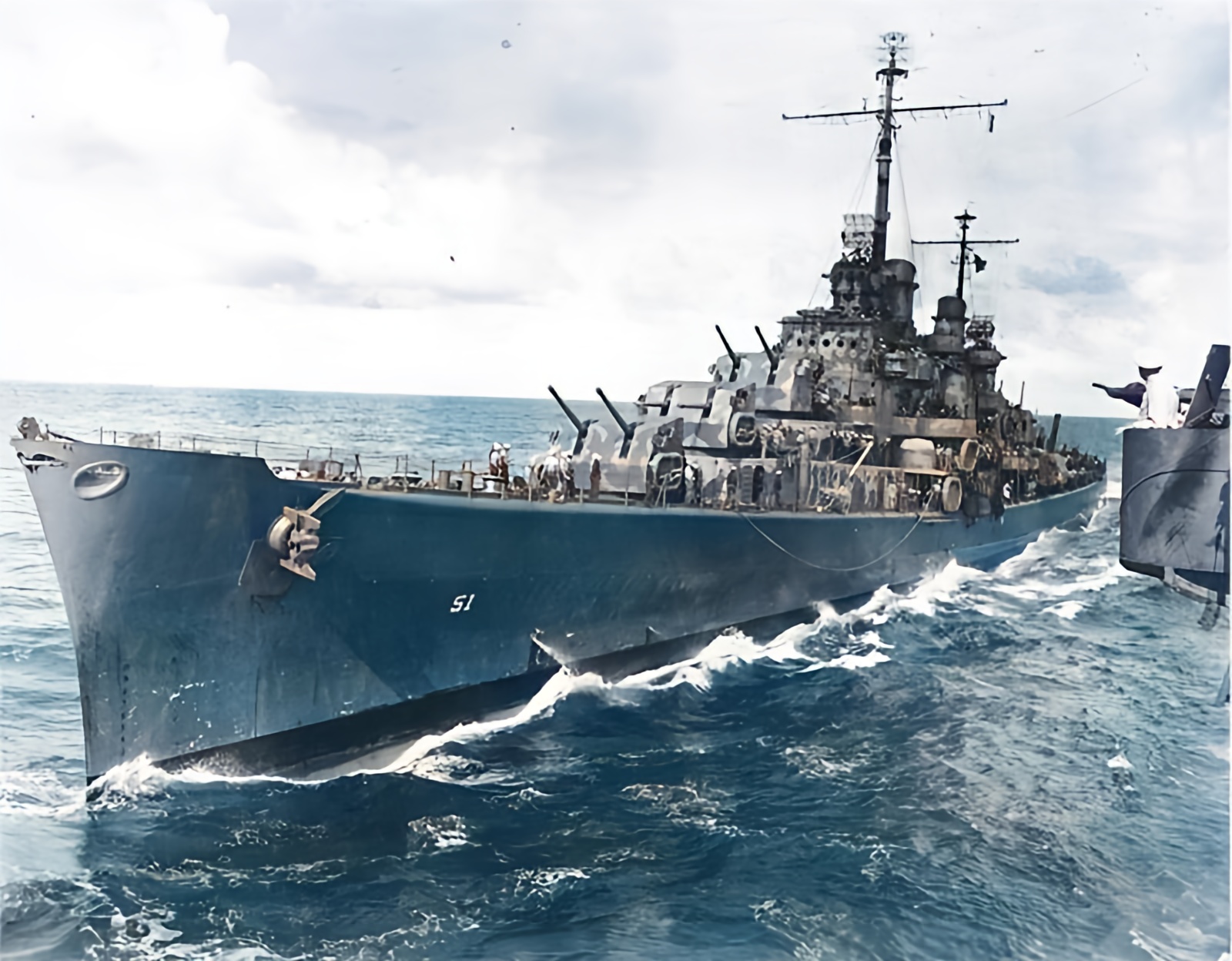
Discover the story of the Atlanta-class cruiser—eight light cruisers that redefined anti-aircraft warfare during World War II.
Atlanta-class cruisers were a series of eight light cruisers built for the United States Navy during the Second World War. Originally designed as scout cruisers and destroyer leaders, these ships quickly proved their worth as effective anti-aircraft warships.
Boasting a formidable armament of 16 x 5-inch guns arranged in eight twin-gun turrets. This layout featured three superfiring turrets forward, three superfiring aft, and two additional waist mounts—providing them with the heaviest anti-aircraft firepower of any cruiser during the conflict. Their design was refined for the final four ships, beginning with the Oakland, which saw the removal of the waist turrets to optimize their performance.
Throughout their service in World War II, Atlanta-class cruisers saw intense action, collectively earning 54 battle stars. Although two ships—USS Atlanta and USS Juneau—were lost during the Naval Battle of Guadalcanal, the remaining six continued to serve until they were decommissioned and eventually scrapped in the 1960s.
Learn more about the USS Atlanta and check out more stories at The Reliable Narrator.
Atlanta-Class Specifications
Atlanta-class cruisers were initially planned as destroyer leaders, but their role evolved into specialized anti-aircraft platforms, equipped with an array of weapons to counter aerial threats during World War II.
Plot Points
Main Armament and Fire Control
The first four ships of the class were armed with eight dual 5-inch (127 mm)/38 caliber gun mounts (8 × 2), making them some of the most heavily armed anti-aircraft cruisers of the war. These guns could unleash over 17,600 pounds (8,000 kg) of shells per minute, including radar-fuzed “VT” shells for precision anti-aircraft fire.
Fire control was managed by two Mk 37 fire control systems, positioned centrally on the superstructure. Initially lacking radar, the class was upgraded in the spring of 1942 with FD (Mk 4) fire control radar, followed by improved Mk 12/Mk 22 radar systems from 1943 onward.
Anti-Aircraft Armament
The first four ships were initially outfitted with twelve 1.1-inch (28 mm)/75 caliber anti-aircraft guns, arranged in three quad mounts. However, by early 1942, a fourth quad mount was added, along with Mk 44 directors for improved targeting. These guns were eventually phased out in favor of the superior Bofors 40 mm anti-aircraft cannons.
Close-range anti-aircraft defenses evolved throughout the war. Originally, eight 20 mm Oerlikon cannons were installed in single mounts across the ship. By 1943, an additional six 20 mm cannons were added, reinforcing protection amidships and aft. In late 1943, a quadruple 40 mm Bofors mounting replaced a twin mount on the quarterdeck. However, as more systems were added, the class suffered from overcrowding and stability issues.
Oakland Subclass
The second group of four ships, known as the Oakland subclass, reflected wartime refinements. These ships were built with six dual 5-inch/38 caliber mounts instead of eight, improving stability while maintaining strong anti-aircraft firepower. The Bofors 40 mm armament was significantly increased, replacing previous mounts and expanding total coverage.
The number of 20 mm cannons was also raised to 16.By the war’s end, some ships, such as USS Oakland, received anti-kamikaze upgrades, including replacing aft twin Bofors mounts with quad mounts, while reducing and consolidating 20 mm cannons into twin mounts. The class’s torpedo tubes, originally installed in two quad 21-inch (533 mm) launchers, were removed in these later modifications.


Anti-Submarine and Sonar Systems
Despite their original destroyer-leader designation, Atlanta-class cruisers were not equipped with sonar or anti-submarine weaponry at launch. By early 1942, they were upgraded with sonar systems and a standard destroyer depth charge battery featuring six projectors and two stern-mounted tracks.
However, when the class’s primary role shifted to anti-aircraft defense, the depth charge projectors were removed, while the stern tracks remained. The Oakland subclass received only two stern tracks, likely due to stability concerns.
Power and Speed
Atlanta-class cruisers were powered by four 665 psi boilers connected to two geared steam turbines, producing 75,000 horsepower (56,000 kW). This allowed them to reach a top speed of 33.6 knots (62.2 km/h; 38.7 mph), with USS Atlanta achieving 33.67 knots (62.36 km/h; 38.75 mph) during trials at nearly 79,000 shp (58,899 kW).
Armor and Crew Capacity
The class had relatively light armor, prioritizing speed and firepower. The machinery and magazines were protected by 3.75 inches (95 mm) of belt armor, while the 5-inch gun mounts had 1.25 inches (32 mm) of protection, and the conning tower had 2.5 inches (64 mm).
Originally designed for 26 officers and 523 enlisted men, the crew size expanded over time due to increased anti-aircraft weaponry and electronics. By the war’s end, the first four ships carried 35 officers and 638 enlisted personnel, while the Oakland-class cruisers housed 45 officers and 766 crew members. These ships were also intended to serve as flagships, providing additional space for a commanding officer and staff. However, in practice, this extra space was repurposed for expanded gun crews and radar operators.
Atlanta-Class Stats
| Specification | |
| Class and Type | Light cruiser |
| Displacement | 6,718 long tons (6,826 t) (standard); 7,400 long tons (7,500 t) (full load) |
| Length | 530 ft (160 m) waterline; 541 ft (165 m) overall |
| Beam | 52 ft 10 in (16.10 m) |
| Draft | 20 ft 6 in (6.25 m) |
| Propulsion | 4 × 665 psi boilers; 2 geared steam turbines; 75,000 hp (56 MW) |
| Speed | 32.5 knots (60 km/h) (design); 33.6 knots (62 km/h) (trials) |
| Range | 8,500 nautical miles (15,700 km) at 15 knots (28 km/h) |
| Boats & Landing Craft Carried | 2–4 × lifeboats |
| Complement | As designed: Officers: 35; Enlisted: 638Oakland class: Officers: 47; Enlisted: 766 |
| Sensors and Processing Systems | 2 × Mk37 GFCS; SC search radar; SG-1 surface-search radar |
| Armament | As designed:– 8 × dual 5″/38 caliber guns- 4 × quad 1.1″/75 caliber guns- 6 × single Oerlikon 20 mm cannons- 2 × quad Mark 15 torpedo tubesOakland class:– 6 × dual 5″/38 caliber guns- 8 × dual Bofors 40 mm guns- 16 × single Oerlikon 20 mm cannons- 2 × quad Mark 15 torpedo tubes |
| Armor | Belt: 1.1–3+3⁄4 in (28–95 mm); Deck: 1+1⁄4 in (32 mm); Turrets: 1+1⁄4 in (32 mm); Conning Tower: 2+1⁄2 in (64 mm) |
Ships in the Atlanta-Class
The eight ships of the Atlanta class saw heavy action in the Pacific theater during World War II. They quickly proved their mettle as dedicated anti-aircraft platforms, protecting US fleets in several intense engagements throughout the war. The class collectively earned 54 battle stars for their service, although two ships were sunk in action: USS Atlanta and USS Juneau.
USS Atlanta (CL-51)
- Builder: Federal Shipbuilding and Drydock Company, Kearny, New Jersey
- Laid Down: April 22, 1940
- Launched: September 6, 1941
- Commissioned: December 24, 1941
Fate:
Sunk at the Naval Battle of Guadalcanal on November 13, 1942.
Service Recap:
As the lead ship of the Atlanta-class, USS Atlanta spearheaded the innovative anti-aircraft concept. She participated in numerous Pacific engagements, culminating in her heroic sacrifice during Guadalcanal.
USS Juneau (CL-52)
- Laid Down: May 27, 1940
- Launched: October 25, 1941
- Commissioned: February 14, 1942
Fate:
Sunk at the Naval Battle of Guadalcanal on November 13, 1942.
Service Recap:
Joining her sister ship Atlanta, USS Juneau quickly became integral to fleet operations. Despite her short service, her loss during Guadalcanal had a profound impact on the Navy and is remembered as a somber moment in World War II history.
USS San Diego (CL-53)
- Builder: Bethlehem Steel Corporation, Fore River Shipyard, Quincy, Massachusetts
- Laid Down: March 27, 1940
- Launched: July 26, 1941
- Commissioned: January 10, 1942
Fate:
Decommissioned on November 4, 1946; struck on March 1, 1959; sold for scrap on February 3, 1960.
Service Recap:
USS San Diego was one of the most decorated US warships of World War II, awarded 18 battle stars. She was also one of the first Allied ships to enter Tokyo Bay after Japan’s surrender.
USS San Juan (CL-54)
- Laid Down: May 15, 1940
- Launched: September 6, 1941
- Commissioned: February 28, 1942
Fate:
Decommissioned on November 9, 1946; struck on May 1, 1959; sold for scrap on October 31, 1961.
Service Recap:
A reliable workhorse in the Atlanta-class, USS San Juan played a key role in securing American naval dominance in the Pacific.
USS Oakland (CL-95)
- Builder: Bethlehem Steel Corporation, San Francisco, California
- Laid Down: July 15, 1941
- Launched: October 23, 1942
- Commissioned: July 17, 1943
Fate:
Decommissioned on July 1, 1949; struck on March 1, 1959; sold for scrap on December 1, 1959.
Service Recap:
As the lead ship of the Oakland subclass, USS Oakland exemplified the improved design philosophy with enhanced anti-aircraft capabilities.
USS Reno (CL-96)
- Laid Down: August 1, 1941
- Launched: December 23, 1942
- Commissioned: December 28, 1943
Fate:
Decommissioned on November 4, 1946; struck on March 1, 1959; sold for scrap on March 22, 1962.
Service Recap:
USS Reno served during the latter stages of World War II, benefiting from the Oakland subclass’s refined design.
USS Flint (CL-97)
- Laid Down: October 23, 1942
- Launched: January 25, 1944
- Commissioned: August 31, 1944
Fate:
Decommissioned on May 6, 1947; struck on June 1, 1965; sold for scrap on October 6, 1966.
Service Recap:
Commissioned late in the war, USS Flint saw limited action. Her relatively brief post-war career led to her early decommissioning and eventual scrapping.
USS Tucson (CL-98)
- Laid Down: December 23, 1942
- Launched: September 3, 1944
- Commissioned: February 3, 1945
Fate:
Decommissioned on June 11, 1949; struck on June 1, 1966; sold for scrap on February 24, 1971.
Service Recap:
As the final member of the Atlanta-class, USS Tucson entered service during the closing stages of World War II. Though her wartime engagement was limited, she continued to serve briefly in the post-war period before being decommissioned and scrapped.
Criticisms of the Atlanta-Class Design
While the Atlanta-class cruisers were formidable warships, several criticisms emerged from their design and operational history.
Combat Vulnerabilities
Despite their advanced anti-aircraft capabilities, Atlanta-class cruisers did not fare well in surface combat. Of the three US Navy’s light cruisers lost during World War II, two—USS Atlanta and USS Juneau—were Atlantas. These ships, which saw combat during the Guadalcanal Campaign, were both sunk: Atlanta was lost in a direct engagement, and Juneau, heavily damaged in battle, was later sunk by a Japanese submarine (I-26) while returning for repairs. Notably, both vessels received fatal blows from Japanese torpedoes and heavy gunfire from larger, more heavily armed ships.
Design Limitations
The design of the Atlanta-class cruisers also came under scrutiny:
- Gunfire Directors: There was a notable shortage of gunfire directors for the main 5-inch battery. This reduced the overall effectiveness of the primary armament.
- Intermediate Anti-Aircraft Guns: Initially, the ships were equipped with an insufficient number of intermediate AA guns, such as the 1.1-inch guns or the Bofors 40 mm systems. Although naval shipyards made improvements by the end of 1942, these enhancements were reactive measures rather than part of the original design.
Stability Concerns
As the war progressed, the addition of extra anti-aircraft guns, radar systems, and other equipment led to issues with topside weight. The Atlanta-class cruisers, already built on relatively light hulls, became increasingly overloaded. This imbalance affected their stability and maneuverability—a problem that persisted throughout the war.
Impact on Future Designs
The criticism and shortcomings of the Atlanta-class led to further refinements in later cruiser designs. The challenges with topside weight and stability, in particular, prompted a redesign that resulted in the development of the Juneau-class cruisers. These new vessels sought to address the issues inherent in the Atlanta-class, emphasizing improved stability and a better balance of weight and firepower.
Reliable Thoughts – A Lesson in Adaptation
The story of the Atlanta-class teaches us that even the most cutting-edge designs can face challenges. Although these ships revolutionized anti-aircraft warfare in World War II, their vulnerabilities in surface engagements and design limitations highlight the inherent trade-offs in naval engineering.
Atlanta-class cruisers, with all their bravery and innovation, continue to inspire a commitment to learning and evolving in the face of adversity.


Leave a Reply