

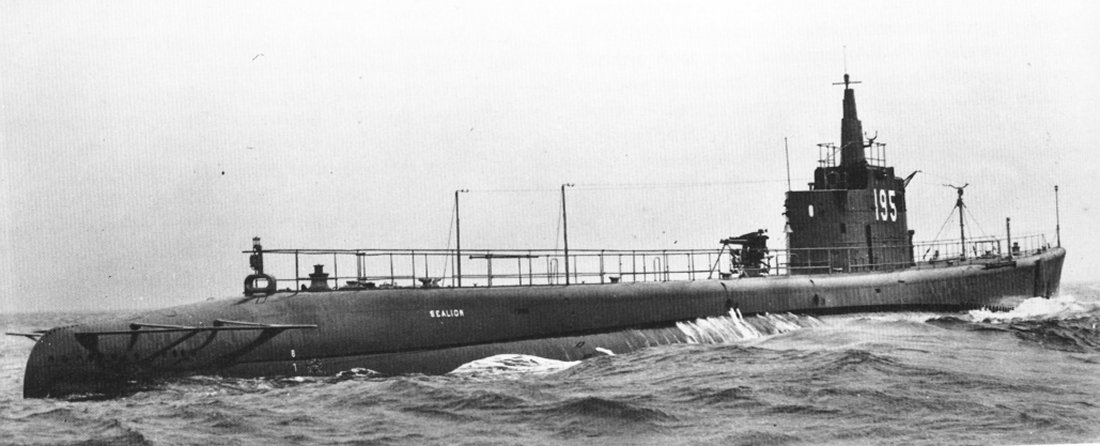
Before Midway. Before the Doolittle Raid. One submarine had already been lost.
Lost 1 of 52
The Pacific War had barely begun.
Just days after the shock of Pearl Harbor, Japan struck again, this time in the Philippines.
In the chaos of that surprise, one American submarine was caught defenseless.
USS Sealion (SS-195) became the first American submarine lost in World War II. She never fired a torpedo. She never escaped the pier. And yet, her loss marked the beginning of the US Navy’s long and costly undersea campaign.
Plot Points
Find More Naval History Stories At The Reliable Narrator


Chapter 1: Born for War
In June 1938, a new Sargo-class submarine was laid down at the Electric Boat Company in Groton, Connecticut. She was USS Sealion, SS-195, the first of her name. At 310 feet long and 27 feet wide, she displaced over 2,300 tons. And with a diesel-electric motor, she could reach 20 knots on the surface and had the range to operate from Pearl Harbor to the coasts of China.
Armed with eight 21-inch torpedo tubes and a 3-inch deck gun, she had a complement of 55 officers and men, representing the cutting edge of undersea warfare.
Commissioned on November 27, 1939, her first commanding officer was Lieutenant J.K. Morrison Jr., a decorated diver who earned distinction during the 1939 rescue of the crew of the sunken USS Squalus.
But tragedy would strike Sealion before war even began.
In February 1940, while docked in St. Petersburg, Lt. Morrison was cleaning a sidearm in the wardroom when it discharged. Fatally wounded, he was taken to the hospital, where he died the following day.
Command passed to Lieutenant Commander Richard G. Voge. Under Voge, Sealion completed her shakedown and transited the Panama Canal, joining America’s Asiatic Fleet at Manila Bay in the Philippines by the end of 1940. There, she began intense training, patrols, and war preparations.
The threat from Japan loomed ever closer.


Chapter 2: Standing Watch
Throughout 1941, Sealion and her sister ship Seadragon maintained a presence in Philippine waters, operating around Luzon and the Sulu Archipelago. These patrols were marked by long hours, tropical heat, and tense encounters. Japan had already launched its invasion of China, and Southeast Asia appeared to be next.
By October, both submarines were due for an overhaul. Sealion entered dry dock at Cavite Navy Yard for an extensive refit, slated for completion by December 12.
But on December 7, 1941 (December 8 in the Philippines), war erupted. Japan struck Pearl Harbor and launched invasions across the Pacific, including in the Philippines. America was thrust into World War II.
USS Sealion, still in drydock, was immobilized—and directly in the path of the oncoming storm.
Chapter 3: Cavite Ablaze
Around noon on December 10, 1941, the sky above Cavite roared with the engines of Japanese bombers. The attack came in two waves. The target: Cavite Navy Yard, the heart of the US Navy’s operations in the Philippines.
Moored at Machina Wharf, Sealion lay alongside Seadragon and the old minesweeper Bittern. With most of the crew below decks, only five remained topside: Commander Voge, Executive Officer Lieutenant Albert Raborn, and three enlisted men.
The first bombs landed close astern, geysering water. A direct hit then struck Sealion‘s conning tower, destroying the bridge fairwater and damaging her control room. Then came the second strike. A bomb pierced her ballast tank and detonated in the aft engine room, killing four men:
- Chief Electrician’s Mate Sterling C. Foster
- Chief Electrician’s Mate Melvin D. O’Connell
- Machinist’s Mate 1st Class Ernest E. Ogilvie
- Electrician’s Mate 3rd Class Vallentyne L. Paul
Shrapnel tore through her aft compartments. Water surged in, and within minutes, Sealion settled by the stern, listing 15 degrees to starboard.
Fires raged across the Navy Yard as survivors scrambled ashore. Cavite was no longer a base. It was a battlefield.
Chapter 4: No Way Home
Sealion was beyond saving. Her engines were gone, her hull breached, and the Navy Yard itself was no longer operational. Even if she could be patched, there was nowhere to send her. The closest base was Pearl Harbor, over 5,000 miles away, and still reeling from its own attack.
Over the next two weeks, her crew salvaged what they could—radios, sonar, codebooks, and torpedoes. These parts helped keep other boats, including Seadragon, in the fight.
Then, on Christmas Day 1941, demolition charges were placed aboard the wreck. At 11:00 a.m., three depth charges exploded within her hull, and USS Sealion was gone.
She had become the first American submarine lost in World War II.
Chapter 5: The Men Who Stayed
The bombing had claimed four of Sealion‘s crew, but the toll would grow. Some of her crew escaped before the final surrender of Bataan and Corregidor. Others joined makeshift Navy battalions that fought on land alongside the Army.
Two sailors—Chief Machinist’s Mate Howard Firth and Seaman First Class Harold Gearhart—were captured by Japanese forces during the fall of the Philippines. Both would die in captivity. Other survivors who were taken prisoner faced years of starvation, abuse, and forced labor until their liberation in 1945.
Commander Voge went on to command USS Sailfish (formerly Squalus). He survived the war and retired as a rear admiral. Also among Sealion‘s officers was a young lieutenant who would one day deliver vengeance: Eli Reich.
Chapter 6: The Second Sealion
In 1943, a new submarine was christened: USS Sealion (SS-315), a Balao-class boat built in memory of the first.
Her skipper? Lieutenant Commander Eli Reich.
On November 21, 1944, in the Taiwan Strait, Reich spotted a Japanese task force. Firing a spread of torpedoes at the battleship Kongō and her escorts, two struck the battleship. She erupted in flames and sank. The destroyer Urakaze was also hit and followed her to the bottom.
Four of those torpedoes bore names: Foster, O’Connell, Ogilvie, Paul. The four crewmen killed aboard the original Sealion at Cavite.
Tribute. Vengeance. Closure.
Reich’s Sealion became the only US submarine in World War II to sink a battleship.
Chapter 7: Aftermath and Memory
The original Sealion remained half-submerged in Manila Bay. When Japanese forces occupied Cavite in early 1942, they found her stripped and scuttled. Engineers raised and moved her to Sangley Point, where she was resunk again.
There she remained until 1959, when a joint US-Philippine salvage operation recovered her wreck. Divers made a grim discovery: the remains of the four men lost in 1941 were still entombed in the aft engine room. Two were returned to their families. Two were buried at sea.
Shortly afterward, Sealion was sold for scrap. While no trace of her remains in Manila Bay, her story lives on.
From Washington, D.C., to Pearl Harbor, Sealion‘s name is carved in stone. Each year, the US submarine force honors the 52 boats lost in World War II during the solemn Tolling of the Boats ceremony.
The first name is always the same:
USS Sealion. Lost at Cavite. December 10, 1941.


Leave a Reply