

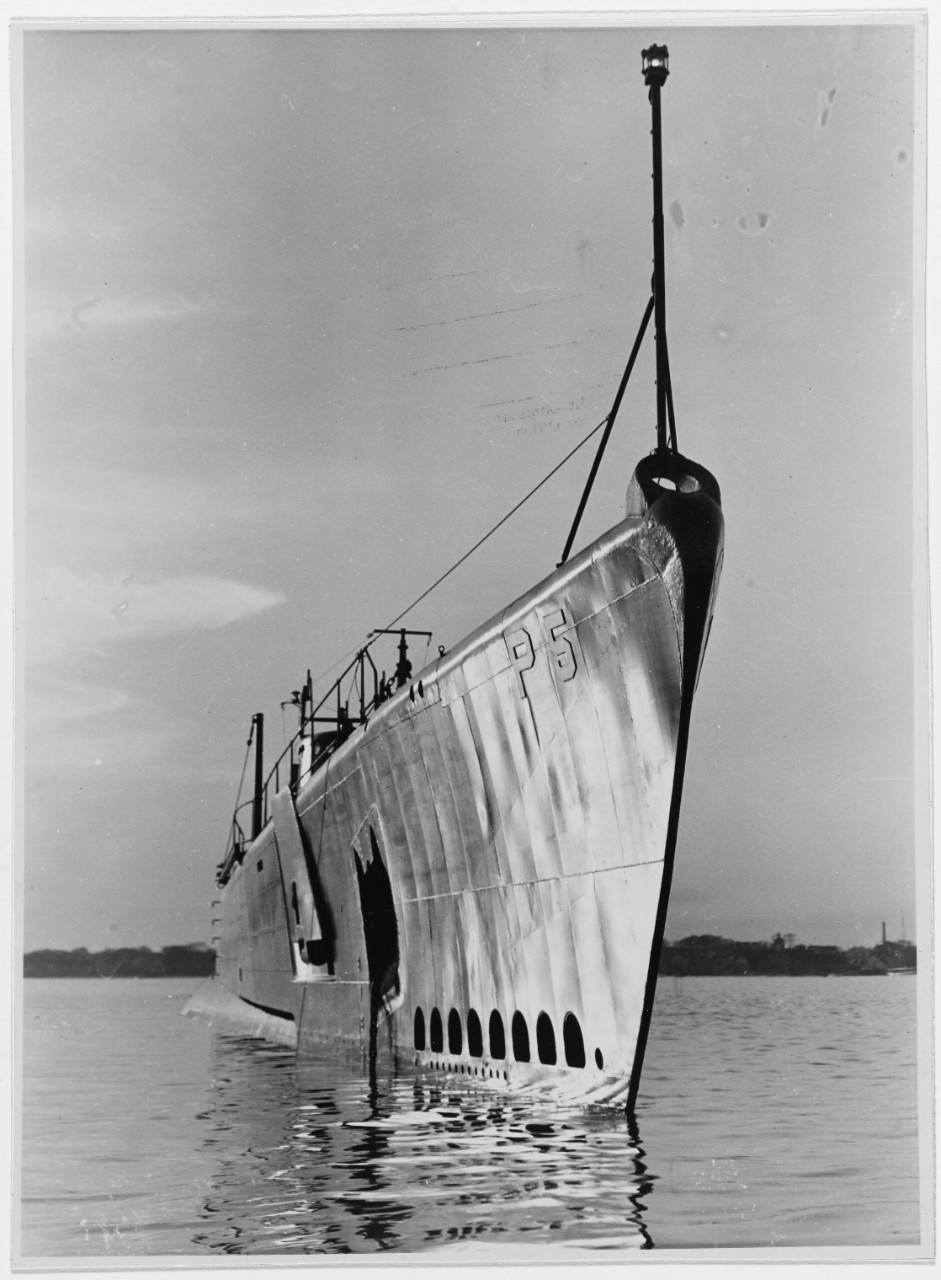
Hunted by Japanese destroyers, USS Perch was scuttled by her crew to avoid capture. Her final dive marked one of WWII’s earliest submarine losses.
Lost 5 of 52
In the predawn darkness of March 3, 1942, USS Perch bobbed crippled in the Java Sea, her hull gashed and systems failing. Depth charges had pounded the submarine into near-ruin, yet she refused to sink. With Japanese warships closing in, her crew faced an agonizing choice: fight on and risk annihilation, or scuttle their own boat.
USS Perch (SS-176) became one of the few American submarines scuttled in the Java Sea during World War II, a boat lost not to enemy fire, but by the hands of her own crew. Yet all 59 men aboard survived the sinking, only to endure years as prisoners in Japan’s brutal labor camps before the war’s end.
From her innovative design to her final, doomed patrol—and the courageous decisions that saved her crew—this is the story of USS Perch, the submarine that refused to sink.
Plot Points


Chapter 1: The Pacific War in Early 1942
By early 1942, the Allied position in the Pacific had collapsed into crisis. Japan’s sweeping offensive was at its peak, overrunning territory across Southeast Asia and the Pacific islands. In the wake of Pearl Harbor, Japanese forces had crippled American defenses in the Philippines and were now pushing south toward the oil-rich Dutch East Indies.
A hastily formed joint command of American, British, Dutch, and Australian (ABDA) forces scrambled to mount a defense. But coordination was poor, resources were thin, and the Japanese advance seemed unstoppable.
In February 1942, as Singapore fell and US forces retreated, Japan turned its sights on Java. The defeat of the ABDA fleet in the Battle of the Java Sea left the island nearly defenseless. Into this chaos, USS Perch and a handful of submarines were sent on desperate patrols, ordered to disrupt enemy landings and delay the inevitable.
For the boats of the Asiatic Fleet, including Perch, the opening months of the war meant operating alone in hostile waters, cut off from support. With Allied bases lost and air cover gone, each patrol grew more dangerous than the last.
By late February, Java was the final Allied stronghold in the region, and the seas around it swarmed with Japanese warships. It was in these waters that Perch would make her final stand against the rising tide of a Pacific War entering its darkest hour.


Chapter 2: Commissioning of USS Perch
USS Perch was born from the Navy’s push to modernize its undersea fleet in the years before World War II. Built by Electric Boat in Groton, Connecticut, she was laid down in 1935 and commissioned on November 19, 1936.
At roughly 300 feet long and displacing about 1,350 tons, Perch marked a step forward in submarine design—larger, faster, and more capable than earlier classes. Her partial double-hull construction and all-electric drive gave her smoother handling and quieter operation, an edge when stalking targets beneath the waves.
Perch was also equipped with six 21-inch torpedo tubes, four forward, two aft, with a typical loadout of 16 torpedoes. A 4-inch/50 caliber deck gun, mounted forward, gave her teeth in surface combat or when finishing off damaged ships. With a surface speed of 19 knots and an impressive range of 11,000 nautical miles, she was built for long patrols across the Pacific.
Perch and her sister ships were true oceangoing submarines, ready to operate far from home.
She was also the first US vessel to bear the name Perch, honoring the quick and aggressive freshwater fish. Her crew would soon prove they were worthy of that name, though none could imagine just how far their courage and endurance would be pushed.
Chapter 3: War Patrols
When war came, Perch was docked at the Cavite Navy Yard in Manila. On December 10, 1941, Japanese bombers devastated the base. Unlike her sister submarine, USS Sealion, Perch narrowly escaped, slipping away from the burning yard. From that moment on, she was at war.
First War Patrol (December 1941)
Under the command of Lieutenant Commander David A. Hurt, Perch slipped through the minefields off Corregidor and headed to sea. In the final weeks of December, she patrolled the shipping lanes between the Philippines, Formosa, and the coast of Japanese-occupied China.
On Christmas night, off Hong Kong, she fired four torpedoes at a large Japanese merchant ship, but missed. Undeterred, she struck again days later, torpedoing and sinking the 5,000-ton freighter Nojima Maru. Although enemy escorts drove her off before she could confirm the kill, postwar records would later verify the sinking.
It was a rare Allied victory in a month marked by defeats.
Low on torpedoes and showing signs of wear, Perch was ordered to Darwin. She arrived in early January 1942 for repairs and resupply, joining a growing number of submarines operating from this last Allied haven after the fall of the Philippines.
Second War Patrol (February 1942)
On February 3, Perch departed Darwin and returned to action. Her new orders: patrol the Java Sea and disrupt Japanese forces. Intelligence reports pointed to multiple enemy convoys, and Perch was redirected several times to investigate their movements.
Skirting Celebes and the Makassar Strait, she shadowed Japanese shipping as it moved south. In mid-February, Perch made a bold move, slipping into the harbor at Kendari, Celebes, for a risky reconnaissance mission. For nearly a week, she lurked in the narrow harbor entrance, hoping to catch an enemy ship at anchor. Though unable to fire, she gathered valuable intelligence and escaped undetected, a testament to the crew’s nerve and skill.
By late February, Perch was prowling the eastern Java Sea, still on the hunt. One moonless night off Celebes, she closed in on a large Japanese freighter. But the ambush went wrong, and the target, or its escort, returned fire.
A shell tore into Perch’s conning tower, blasting away her bridge deck and punching through the antenna trunk, knocking out her radio and leaving a gaping hole in her upper hull.
With calm and steady leadership, Captain Hurt took the submarine deep to escape. That night, Perch surfaced under the cover of darkness, and the crew went to work. They patched the conning tower, jury-rigged the radio, and braced the damaged bridge—working by hand under blackout conditions while enemy patrols searched nearby waters.
Though battered, Perch turned back toward Java. Hurt and his crew were determined to find the enemy and strike, no matter the odds.
Chapter 4: The Last Battle
As February turned to March 1942, Perch embarked on what would become her final mission. With Japanese forces closing in on Java, Allied commanders ordered every available submarine to intercept likely landing zones along the island’s northern coast.
On the night of March 1, Perch patrolled 30 miles north of Surabaya. Surfaced to recharge her batteries, her lookouts scanned the sea for enemy transports. Instead, they spotted two fast-approaching silhouettes: the Japanese destroyers Amatsukaze and Hatsukaze.
Searchlights swept across the waves. A moment later, the destroyers opened fire. Shells exploded around Perch as she crash-dived, narrowly escaping destruction. But the worst was yet to come.
The destroyers launched a relentless depth-charge attack. The first patterns exploded at a distance. The second struck home.
Shockwaves tore through the hull. Steel plates buckled inward by nearly two feet. Lights shattered. Pipes burst. Water seeped through fractured seals.
Ninety percent of Perch’s instruments were knocked out, leaving the crew effectively blind. In the control room, shattered gauges spun uselessly as the submarine plunged to the seafloor, settling at 147 feet.
Above, rising oil and air bubbles convinced the Japanese they had destroyed their target. The destroyers moved on.
Miraculously, Perch had survived.
After two tense hours on the bottom, Commander David Hurt and his crew coaxed the battered submarine back to the surface under the cover of night. The damage was staggering: the conning tower was stove in, the periscopes shattered, and only two of her four engines could be started. But she floated.
Hurt set a westerly course, hoping to reach friendly waters. Crawling through enemy territory, the crew patched leaks and worked to keep the submarine alive. With the radio disabled, no help was coming.
Just before dawn on March 2, disaster struck again.
The Japanese destroyers Ushio and Sazanami spotted Perch on the surface and moved to attack. She crash-dived once more—but her luck had run out.
The destroyers pounded her with depth charges. Explosions rocked the sub. Propulsion failed. The rudder jammed. Inside, heat rose, batteries shorted, and the air turned foul. For hours, the crew lay silent in the dark, as the destroyers circled above.
By afternoon, the Japanese ships departed, confident the submarine was finished. That night, Perch surfaced again—barely afloat. Her hatches leaked. Seawater trickled through fractured bulkheads. Nearly every system had failed.
The crew worked through the night. They managed to start one engine, giving her just enough power to limp forward at five knots. A test dive nearly sank her. Perch surfaced for the last time.
By the evening of March 3, the crew discussed scuttling the boat—but held off, still hoping for a chance to escape. But fate wasn’t finished with them. Ushio and Sazanami, still on patrol, encountered the submarine once again.
Sazanami held fire. Ushio did not.
As the first shell struck the conning tower, the order to scuttle was given. The crew opened the seacocks, set charges, and began abandoning ship. One by one, they leapt into the sea as Perch filled with water. The submarine slipped beneath the waves for the last time.
Incredibly, every man survived.
Drifting in the Java Sea, clinging to rafts and wreckage, the crew awaited their fate. In a rare act of mercy, Ushio returned—not to finish them, but to rescue them.
All 59 crewmen of Perch had survived their submarine’s final dive. But their war was not over.
They were now prisoners—some of the first American submarine POWs of World War II.
Chapter 5: Survival as POWs
After their capture, the crew of USS Perch was transported under guard to Japanese-occupied Java and eventually shipped to prisoner-of-war camps. Their first stop was the secretive Ofuna interrogation center in Japan, where high-value POWs were subjected to harsh and prolonged questioning.
Most of Perch’s crew, including Commander Hurt, were then sent to the Ashio copper mines in the mountains of Japan. There, they endured forced labor under grueling conditions—scant food, brutal workloads, and almost no medical care. Yet in the darkness of captivity, Hurt remained a steady, unifying figure, bolstering morale and keeping his men together.
Tragically, not everyone made it home. Five of Perch’s crew died in captivity, taken by malnutrition, illness, or abuse. But against all odds, the majority endured. When Japan surrendered in August 1945, their ordeal finally came to an end.
In September, 54 men of Perch’s crew were liberated and began the long journey home. But their return was bittersweet; joy at reunion tempered by grief for lost shipmates and the invisible scars of nearly four years in captivity.
Their survival, from the depths of the Java Sea to the mines of Ashio, remains one of the most extraordinary stories in the history of the Silent Service. Few US submarines lost in World War II saw any of their crews return. Perch’s survived together.
Chapter 6: Legacy and Remembrance
For decades, the final resting place of USS Perch remained a mystery. Scuttled in the Java Sea to avoid capture, she vanished beneath the waves—another name on the list of the Lost 52.
Then, on November 23, 2006, an international team of divers searching for the wreck of HMS Exeter picked up a submarine-shaped contact on sonar. When they descended, they found a remarkably intact submarine. A corroded plaque on the conning tower confirmed the discovery: USS PERCH.
For a moment, history resurfaced. The find made headlines. Photographs and footage documented the wreck, lying silent beneath 190 feet of water—her story, it seemed, complete at last.
But the moment didn’t last.
In the years that followed, Perch’s wreck was targeted by illegal salvagers—a fate that has befallen many WWII shipwrecks in Southeast Asia. By the mid-2010s, her remains had been stripped for scrap. The site, once a memorial, was left barren.
Epologue
The story of USS Perch is a story of survival. A submarine that refused to go down until her crew was safe.
Lost early in the war, Perch didn’t have time to build a long combat record. But in her final hours, she and her crew forged a deeper legacy—one of courage, resilience, and sacrifice.
After the war, several of her men were honored for their valor. Most notably, Lieutenant (j.g.) Kenneth G. Schacht was awarded the Navy Cross. As Perch was scuttled, he volunteered to stay aboard, ensuring that sensitive equipment and codes were destroyed under enemy fire. He was the last man off the submarine, escaping through the conning tower as she sank beneath him.
Their story was later dramatized in an episode of the 1950s television series The Silent Service, and in 1944, the U.S. Navy commissioned a new USS Perch (SS-313), ensuring the name would sail again.
Today, USS Perch is remembered as the fifth of the 52 American submarines lost in World War II. Her story is shared in memorial ceremonies and submarine veteran circles—not only as a tale of loss, but as a rare and remarkable story of survival.
Nothing remains of Perch beneath the Java Sea. But her legacy lives on—in history, in memory, and in the hearts of those who serve beneath the waves.
She was the submarine that refused to sink—until her men were safe.


Leave a Reply