

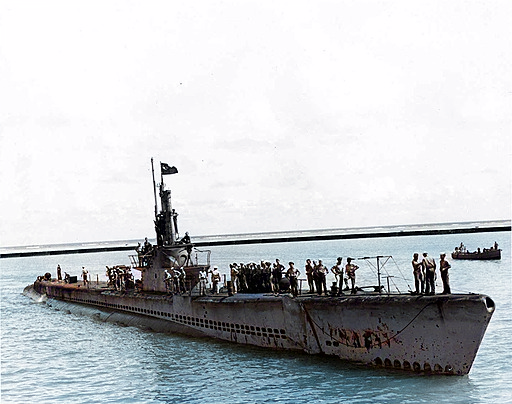
The story of USS Bullhead (SS-332), a Balao-class submarine whose tragic fate marked the last US submarine loss of World War II.
USS Bullhead (SS-332) was a Balao-class submarine with a remarkable but ultimately heartbreaking history. Commissioned on December 4, 1944, she was one of 120 submarines of her class, designed to operate in the Pacific Theater. Though her service was short, Bullhead exemplified the bravery and sacrifice of the US Silent Service.
On her final patrol in August 1945, just days before Japan’s surrender, Bullhead was sunk by a Japanese aircraft, resulting in the loss of all 84 aboard. Unlike USS Albacore’s wartime record, Bullhead’s sinking made her the last US submarine lost in World War II.
Plot Points
Balao-Class Submarines
USS Bullhead was part of the Balao-class, the most produced submarine of WWII. Slightly improved from the Gato-class, these submarines were 312 feet long, with a displacement of 1,526 tons. They also featured thicker pressure hulls, allowing them to dive to depths of 400 feet.
Armed with 10 torpedo tubes and a five-inch deck gun (two after late-war refits), Balao-class submarines were formidable. Powered by diesel-electric engines, they could travel at 20 knots on the surface and 8.75 knots submerged, with a range of 11,000 nautical miles. These features enabled submarines like Bullhead to operate deep in enemy territory for extended periods of time.
A Short but Impactful Service
Bullhead conducted three war patrols in her brief service. Her missions involved reconnaissance, lifeguard duties for downed pilots, and attacks against Japanese shipping.


First War Patrol
Before USS Bullhead embarked on her first war patrol, an unusual guest joined her crew. Vice Admiral Charles Lockwood introduced Commander Walter Griffith to Martin Sheridan, a Boston Globe war correspondent. Sheridan had just completed coverage of B-29 firebombing raids over Tokyo and, with approval from Fleet Admiral Chester Nimitz, secured permission to accompany Bullhead. This made Sheridan the only journalist to experience a submarine war patrol during the Second World War.
Bullhead departed Apra Harbor on March 21, 1945, for the South China Sea, tasked primarily with lifeguard duty. On April 8, a US B-24 Liberator mistakenly dropped bombs near Bullhead, narrowly missing her.
Later that month, on April 16, she rescued three US airmen just four miles off the Japanese-controlled Chinese coast, forcing Griffith to destroy decoding equipment as a precaution before the rescue.
The challenges didn’t stop there. On April 19, as Bullhead patrolled the South China Sea, an aircraft dropped two depth charges as the submarine dove to avoid detection. The charges detonated at 100 feet, but Bullhead emerged unscathed.
Concluding her patrol on April 28, Bullhead returned to Subic Bay. The presence of Martin Sheridan shed light on the realities of submarine warfare, capturing the public’s imagination. However, the experiment was short-lived, as Fleet Admiral Ernest King banned correspondents from future submarine patrols.
Second War Patrol
After a brief refit and training, Bullhead departed Subic Bay on May 21, 1945, for her second war patrol. This mission saw her traverse the South China Sea toward the Gulf of Siam, where she engaged in more direct combat.
The first weeks of the patrol were relatively uneventful, with Bullhead sinking a small 150-ton lugger off the Thai coast on May 30. However, by mid-June, she began to see more intense action.
On June 19, Bullhead staged an aggressive surface attack near St. Nicholas Point, Java, sinking or damaging several small Japanese freighters. On June 24, the submarine spent hours shadowing a large ship—estimated at 8,000 to 10,000 tons—marked with red cross insignia. Suspicious of its movements, Griffith sought permission to engage but was denied, respecting wartime rules against attacking hospital ships.
Bullhead’s final notable act on this patrol was the rescue of ten Javanese conscripts from a Japanese coastal freighter she had sunk. After interrogating one of the survivors with the help of a Dutch-speaking crew member, the rescued men were released.
Bullhead concluded her second patrol at Fremantle, Australia, on July 2, 1945. By the end of her mission, she had claimed 1,850 tons sunk across four vessels and 1,300 tons damaged in three others—all achieved through gun actions.
Bullhead’s Final Patrol
On July 31, 1945, Bullhead departed Fremantle for her third war patrol. Again assigned to the South China Sea, she was to join an effort to weaken Japanese operations in the area. Tragically, she would never return.
On August 6, 1945, a Japanese Mitsubishi Ki-51 bomber spotted Bullhead near the Lombok Strait between Bali and Indonesia. Dropping depth charges with deadly accuracy, the attack sank the submarine, killing all aboard.
Bullhead’s sinking occurred the same day the atomic bomb was dropped on Hiroshima. Her loss marked the last US submarine loss of World War II, just nine days before Japan’s formal surrender on August 15, 1945.
Reliable Thoughts
The story of USS Bullhead highlights the courage of the Silent Service during World War II. Operating in isolation and under constant threat, these submariners faced unimaginable challenges. Bullhead’s loss in the war’s final days is a reminder of the sacrifices required for victory. Her legacy, like that of her crew, lives on as a testament to the bravery and dedication of those who served.


Leave a Reply