

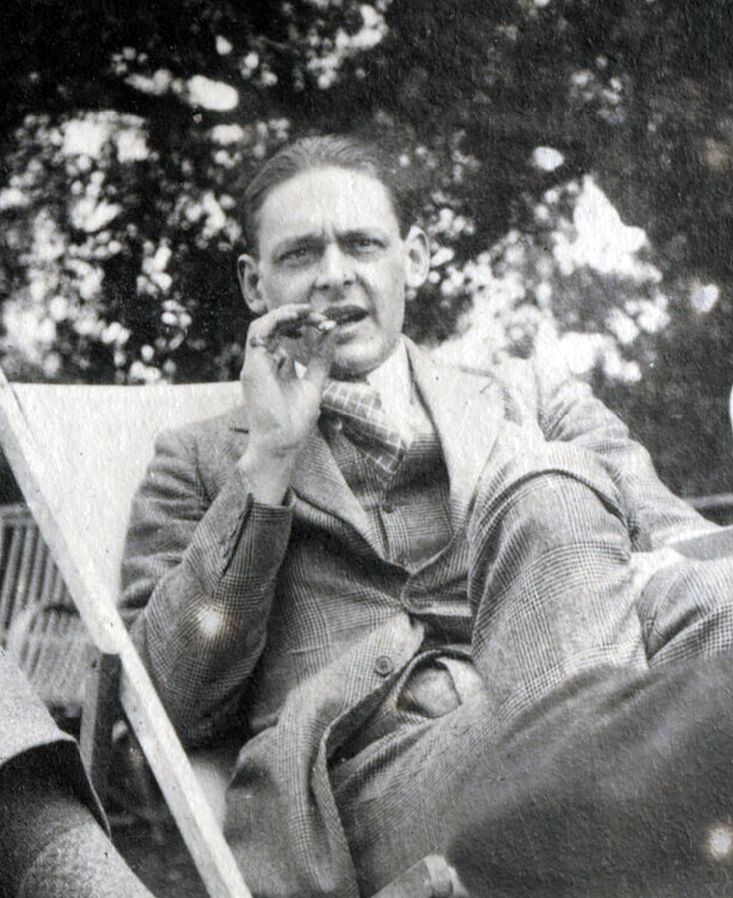
T. S. Eliot was born today in writing history, September 26. Celebrate the occasion by learning more about the writer’s life and contributions to the literary world. Aspiring writers should also use this opportunity as a writing exercise. Look for inspiration today in writing history.
Today in Writing: September 26: T. S. Eliot’s Birthday
T. S. Eliot was born on September 26, 1888. Eliot is best known for his poems The Love Song of J. Alfred Prufrock and The Waste Land. He is considered one of the foremost poets of the 20th century. Learn more about the author’s life and find something to write about in this edition of Today in Writing.
Writing Prompts for Today In Writing: September 26
Take this opportunity to learn more about T. S. Eliot and his contributions to writing. From an early age, Eliot was an avid reader and literature lover. He was also profoundly affected by the things he saw and experienced, which is reflected in his prose. Find inspiration about the author, learn more details about his life, and find a topic to write about below.
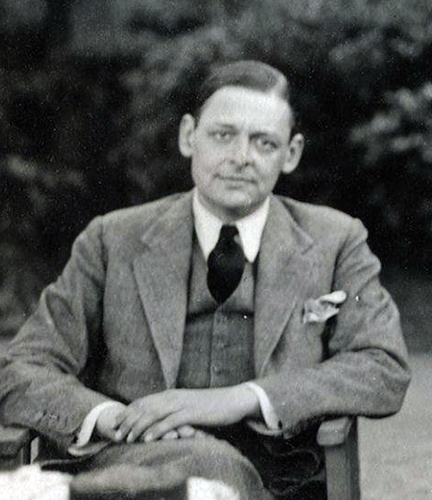
T. S. Eliot Biography
Thomas Stearns Eliot was born in Saint Louis, Missouri, on September 26, 1888. His family was from the upper class of Boston, but Eliot’s grandfather, William Greenleaf Eliot, had moved to the Midwest to start a Unitarian church.
Eliot’s father, Henry, had become a successful businessman in Saint Louis. Eliot’s mother, Charlotte Champe Stearns, was a social worker passionate about writing poetry. T. S. Eliot’s love of literature began at a young age.
Early Love of Literature
As a child, T. S. Eliot suffered from a congenital double inguinal hernia and could not participate in physical activities with other boys. Instead, he turned to books. From the moment he learned to read, Eliot immersed himself in literary works set in the Wild West, and full of adventure, like Tom Sawyer.
T. S. Eliot also credits the city of Saint Louis for fueling his passion for reading. This love of literature inspired the aspiring writer to start writing poetry. As early as 14, Eliot was writing poetry. His first published poem appeared in his school’s newspaper in February 1905. That same year would see a handful of other poems and three short stories published.
Eliot’s Higher Education
Eliot enrolled at Harvard in 1906. His love of literature continued to flourish, and he earned his Bachelor’s and Master’s degrees in English literature by 1910. During his time on campus, Eliot was also introduced to Arthur Symons’s The Symbolist Movement in Literature, a book on the symbolist movement in French literature. It introduced T. S. Eliot to several French writers and poets that would heavily influence his writing style.

After graduating, Eliot moved to Paris, where he spent a year studying philosophy at the Sorbonne. However, he would return to Harvard in 1911 to study Indian philosophy and Sanskrit until 1914, when T. S. Eliot was awarded a scholarship to attend Merton College in Oxford, England.
As World War I broke out in Europe, Eliot would leave Merton and work a string of teaching positions. Arriving in London, T. S. Eliot would meet Ezra Pound on September 22, 1914. Pound, an influential figure in American literature, took a keen interest in an aspiring Eliot.
Ezra Pound is credited as being a vital mentor for T. S. Eliot’s early career. The two writers became quick friends and were often inseparable. However, Pound also promoted Eliot’s work, and would play a key role in getting The Love Song of J. Alfred Prufrock published in 1915.
T. S. Eliot Marries Vivienne Haigh-Wood
Early in 1915, Eliot was introduced to Vivienne Haigh-Wood, a governess in Cambridge. The two were married shortly after that, on June 26, 1915, at the Hampstead Register Office. However, the marriage was marked by unhappiness. Although never confirmed, it is rumored that Vivienne had an affair with British intellectual Bertrand Russell.
Additionally, Vivienne suffered from various medical ailments and was constantly in the care of doctors. The constant physician visits developed an addiction to opium and other prescription drugs. Eliot himself was an excessive drinker. The volatile couple was often at odds with each other.
T. S. Eliot and Vivienne would eventually separate in 1933, as her mental stability continued to decline. Her brother committed Haigh-Wood, against her will, to a mental hospital in 1938. She would remain there until her death in 1947.

Although Eliot would admit the marriage never brought him happiness, his reaction to the news of her death is worth noting. T. S. Eliot received a phone call informing him that Vivienne had died unexpectedly. The poet reportedly buried his face in his hands and cried out, ‘Oh God, oh God.’
Eliot’s Citizenship
T. S. Eliot would spend most of his life in England. The affection for the country led to Eliot making moves to better ingratiate himself with the British. On June 29, 1927, Eliot renounced his Unitarian faith and converted to Anglicanism, the Church of England. Later that year, in November, T. S. Eliot renounced his American citizenship to officially become a British citizen.
T. S. Eliot, The Love Song of J. Alfred Prufrock
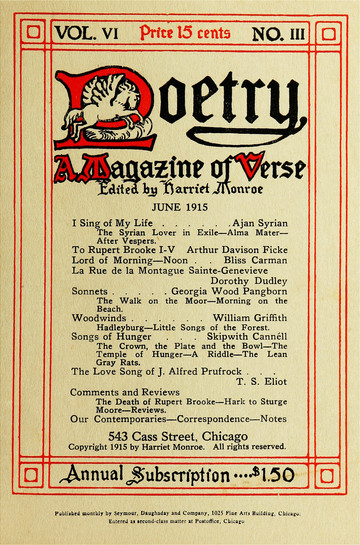
T. S. Eliot published The Love Song of J. Alfred Prufrock in June 1915. It was first published in an issue of Poetry: A Magazine of Verse, but would later be printed as a pamphlet, Prufrock and Other Observations, in 1917. Ezra Pound, an editor for the magazine, championed the owner to include Eliot’s poem.
Most readers did not readily accept the work at the time. Eliot’s poem was considered shocking and offensive. According to one review: The fact that these things occurred to the mind of Mr. Eliot is surely of the very smallest importance to anyone, even to himself. They certainly have no relation to poetry.
T. S. Eliot began writing The Love Song of J. Alfred Prufrock as early as 1910. The symbolism movement in French literature heavily influenced his writing style. The poem was also influenced by several works of classical literature, such as Dante’s Inferno and Shakespeare. Many of these works are referenced in the prose. The narrative style of the poem is also akin to stream-of-consciousness writing.
The Love Song of J. Alfred Prufrock
Let us go then, you and I,
When the evening is spread out against the sky
Like a patient etherized upon a table;
Let us go, through certain half-deserted streets,
The muttering retreats
Of restless nights in one-night cheap hotels
And sawdust restaurants with oyster-shells:
Streets that follow like a tedious argument
Of insidious intent
To lead you to an overwhelming question …
Oh, do not ask, “What is it?”
Let us go and make our visit.
Excerpt from T. S. Eliot’s, The Love Song of J. Alfred Prufrock
Eliot’s Later Life and Death
Over the next two decades of his life, Eliot would continue to produce poems that would receive public praise and recognition. The Waste Land, written during his troubled marriage, and The Hollow Men, written in the wake of post-war Europe, were both published in the 1920s and brought the author critical acclaim.
His health began to fail in the 1960s, but he continued to write and work as an editor, seeking out the talents of upcoming aspiring writers. T. S. Eliot died of emphysema in his London home on January 4, 1965. He was 76 years old.
Notable T. S. Eliot Poems
Prufrock and Other Observations, (1917)
The Waste Land, (1922)
The Hollow Men (1925)
Journey of the Magi, (1927)
A Song for Simeon, (1928)
Animula, (1929)
Ash-Wednesday, (1930)
Marina, (1930)
Triumphal March, (1931)
Old Possum’s Book of Practical Cats, (1939)
East Coker, (1940)
Burnt Norton, (1941)
The Dry Salvages, (1941)
Little Gidding, (1942)
Four Quartets, (1943)
Today in Writing: September 26 – 15 T. S. Eliot Quotes
T. S. Eliot is one of the most renowned poets of the 20th century. Although he did not author many poems for a poet of such standing, the ones he did left their mark in the literary world. His love for literature also made Eliot a prominent voice in literary criticism.
15 Quotes From T. S. Eliot
1. This is the way the world ends, not with a bang, but a whimper.
2. Immature poets imitate; mature poets steal.
3. I will show you fear in a handful of dust.
4. You are the music while the music lasts.
5. Only those who will risk going too far can possibly find out how far one can go.
6. I have measured out my life with coffee spoons.
7. The communication of the dead is tongued with fire beyond the language of the living.
8. This love is silent.
9. If you aren’t in over your head, how do you know how tall you are?
10. Genuine poetry can communicate before it is understood.
11. We shall not cease from exploration, and the end of all our exploring will be to arrive where we started and know the place for the first time.
12. People to whom nothing has ever happened cannot understand the unimportance of events.
13. The business of the poet is not to find new emotions, but to use the ordinary ones and, in working them up into poetry, to express feelings which are not in actual emotions at all.
14. It’s not wise to violate rules until you know how to observe them.
15. April is the cruellest month.
Today in Writing: September 26 – Daily Writing Exercise
Now that you have done some reading, it is time to write. Aspiring writers should look to the stories from T. S. Eliot’s life for their own inspiration. Check through the quotes to spark an idea or read some of Eliot’s poems to learn from one of the most influential poets of the 20th century.
Find a topic from Today in Writing: September 26 and freewrite for 10 minutes. T. S. Eliot was a poet that loved wordcraft and his poetry has left a lasting effect on literature. In the words of Eliot himself: Immature poets imitate; mature poets steal. Practice your ability to imitate one of the greats.
Don’t let any opportunity to write go to waste. Aspiring writers: Practice your writing today! Celebrate Today in Writing History September 26.


Leave a Reply