

Today in writing history for September 13:
Today in Writing: September 13: Roald Dahl’s Birthday
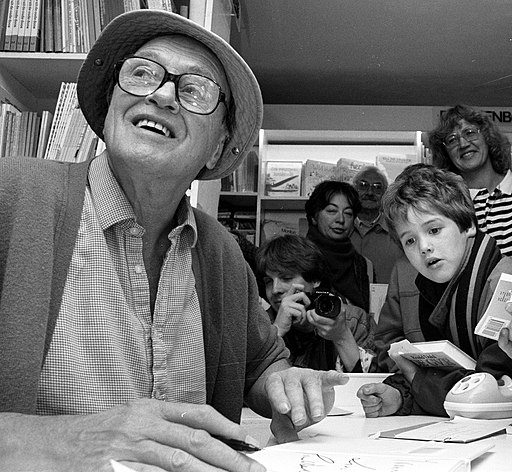
Roald Dahl was born on September 13, 1916. Dahl was a British writer known for his contributions to children’s literature. His books have sold over 250 million copies worldwide and include cherished titles such as Willy Wonka and the Chocolate Factory, James and the Giant Peach, and Matilda.
Additional Facts About Roald Dahl
Please take this opportunity to learn more facts about Roald Dahl’s life and his literary contributions. Dahl is regarded as one of the great storytellers for children in the 20th century. Aspiring writers should also use this option as a writing exercise. Find inspiration and learn more information about Roald Dahl.
Roald Dahl Biography
Roald Dahl was born in Wales, the United Kingdom, on September 13, 1916. His parents were immigrants from Norway, so Norweigan, the language spoken at home, was Roald’s first language. His father, Harald Dahl, a wealthy shipbroker, died of pneumonia when Roald was 3. Harald wanted his family to be educated in English schools, considered the best in the world at the time, so the Dahl family remanded in England.
Dahl’s School Experience
At 13, Dahl attended Repton School. He describes terrible conditions at the boarding school, including severe hazings and a harsh environment supported by the older students and school faculty. Dahl has said the horrors he witnessed were things he could never get over. According to his autobiography, in May 1933, Dahl saw a friend severely caned by the school’s headmaster, Geoffrey Fisher, who later became Archbishop of Canterbury. The experience was so traumatic that Dahl is on record saying it caused him to doubt religion.
Service During World War II
After finishing school, Dahl worked with Shell Petroleum in Africa. With World War II looming in August 1939, he was commissioned as a lieutenant into the King’s African Rifles. He joined the Royal Air Force alongside sixteen other cadets a few months later. Only three of those cadets would survive the war. Dahl served impressively in the African campaign as a pilot in the RAF.
While on a mission on September 19, 1940, Dahl was given the wrong coordinates and could not find his airstrip. Low on fuel, and with night approaching, he was forced to land in the Libyan desert. The landing was unsuccessful, and the resulting crash fractured Dahl’s skull, broke his nose, and left him temporarily blind. Despite his injuries, he managed to drag himself from the burning wreckage and was rescued.
Dahl would recover his sight and pilot more missions during the war. However, the onset of severe headaches that would cause him to black out led to him being invalided. He was sent home to England in 1941. Dahl was reassigned to a diplomatic mission in Washington, DC, where he would begin writing. His first publication was an account of his crash landing in Libya.
During this time, he also became involved in British espionage, reporting directly to Winston Churchill. Dahl described his job as: “try[ing] to help Winston to get on with FDR, and tell Winston what was in the old boy’s mind.” During this line of work, Dahl worked alongside Ian Flemming, author of the James Bond novels.
Post-War Life and Writing Career
Dahl’s writing career began during his diplomatic assignment to the United States. The story of his crash landing, originally titled ‘A Piece of Cake,’ was published in the August 1, 1942 issue of The Saturday Evening Post as ‘Shot Down Over Libya.’ He would go on to publish his first children’s book in 1943. The Gremlins was an adaptation of areal folklore involving mischievous creatures. Walt Disney commissioned the book for a movie adaptation, but it was never made.
Dahl continued to author some of the most well-known books for children in the 20th century. He married American actress Patricia Neal on July 2, 1953, and would have five children. His daughter Olivia died of measles on November 17, 1962, at the age of seven. His novel, The BFG, is dedicated to her memory. Olivia’s death left Dahl feeling guilty he could not do anything, which made him a proponent of immunization. It also deepened his disillusionment with his faith in Christianity.
In addition to his books, Dahl also wrote for film and television. He wrote two screenplays based on novels by Ian Flemming. Chitty Chitty Bang Bang and the James Bond film You Only Live Twice were penned by Dahl. Additionally, he wrote for and hosted the television series Way Out, a precursor of The Twilight Zone. He died on November 23, 1990, from a rare form of blood cancer.
Notable Roald Dahl Books
The Gremlins (1943)
James and the Giant Peach (1961)
Charlie and the Chocolate Factory (1964)
Fantastic Mr Fox (1970)
Charlie and the Great Glass Elevator (1972)
George’s Marvellous Medicine (1981)
The BFG (1982)
The Witches (1983)
Matilda (1988)
The Minpins (1991)
Charlie and the Chocolate Factory and Movie Adaptations
Dahl began the adaptation of Charlie and the Chocolate Factory for the silver screen. However, the author failed to meet deadlines. The novel was adapted by someone else and produced as Willy Wonka & the Chocolate Factory.
Dahl disowned the film. In his opinion, the movie deviated too much from his original plot and focused on Willy Wonka, not Charlie. Dahl would not allow any of his other novels to be adapted during his lifetime. That included the sequel to the chocolate factory saga, Charlie and the Glass Elevator.
Themes in Roald Dahl’s Writing
Roald Dahl’s children’s novels share several similarities in theme and writing style. A number of these elements harken back to experiences in Dahl’s life. His style and ability to tell a story have connected with generations of readers across the globe.
Evil Adults
Most of Dahl’s novels for children contain evil adult characters. The author’s own experiences in boarding school seem to influence these personalities. Dahl uses these characters repeatedly, from the villainous Miss Trunchbull in Matilda to the other giants in The BFG (Big Friendly Giant). His novels also contain a singular good adult as a counter to the adult villains.
Child’s Point-of-View
The main characters in Dahl’s novels are children. Relating to the audience is an important concept to consider for writers. Creating a main character that is a child for a book intended for children is a perfect illustration of writing for an audience. Dahl identifies his audience and writes for them.
Trolls and Giants
Several of Dahl’s books contain trolls and giants. Likely a result of his Norwegian heritage, other aspects of Norway’s mythology are found in his writing. The BFG, Fantastic Mr Fox, and The Minpins all include examples of these elements.
Roald Dahl’s Writing Rules
Dahl had 8 rules for writing. They were immortalized in Roald Dahl’s Revolting Rulebook, a TV documentary celebrating the author’s 90th birthday. The special event also honored his contribution to children’s literature.
Roald Dahl’s 8 Writing Rules
- Just add chocolate
- Adults can be scary
- Bad things happen
- Revenge is sweet
- Keep a wicked sense of humor
- Pick perfect pictures
- Films are fun…but books are better!
- Food is fun!
By adhering to these principles, Roald Dahl created a unique and fascinating writing style. Dahl applied these rules to all of his books. His style has captured the attention and inspired the imagination of millions of readers.
Inventing Words
Dahl was also known for his wordplay and ability to invent new terms. He believed that creating new and exciting words would keep his readers from closing his books and watching television. Invented words like ‘snozzberry‘ and ‘scrumdiddlyumptious‘ have entered the modern vocabulary. A dictionary honoring Dahl’s 100th birthday contains nearly 8000 real and invented words from his texts.
Roald Dahl’s Writing Space
Aspiring writers should note the importance of a dedicated writing space. Desks, cafes, or park benches could be ideal places to work out ideas onto the page. Roald Dahl was no stranger to this concept. He famously wrote from a ‘writing hut’ in his backyard.
Dahl’s hut was nothing impressive, but it did give him a quiet place to center himself and write. He also filled the spaces with a handful of curiosities to inspire him. One of these relics was his hip bone, which he had replaced.
Today in Writing: September 13 – Roald Dahl Quotes
Roald Dahl was a master of children’s literature. His ideas and writing style have left a lasting impression on youthful readers. Dahl’s ability to invoke imagination and wonder is a long-lasting legacy.
Roald Dahl Quotes
Those who don’t believe in magic will never find it.
If you are going to get anywhere in life you have to read a lot of books.
Somewhere inside all of us is the power to change the world.
The matter with human beans,’ the BFG went on, ‘is that they is absolutely refusing to believe anything unless they is actually seeing it right in front of their own schnozzles.
You should never, never doubt something that no one is sure of.
Today in Writing: September 13 – Aspiring Writers Daily Writing Exercise
Do any of the stories from Roald Dahl’s life inspire you? Do any of Dahl’s contributions to literature give you an idea? Do any of his quotes inspire you?
Find a topic from today’s update and freewrite about it for at least 5 minutes. Don’t let any opportunity to write down an idea go to waste. Aspiring writers: Practice your writing today! Celebrate Today in Writing History September 13.


Leave a Reply