


One of Graham Greene’s best books, “The Quiet American,” is a relatively hidden story. Written in 1955, interpreted the cautionary tale as an “anti-American” novel. As the United States’ involvement in Vietnam began to rise, the book was thought to portray Americans as murderers.
Although very popular in England, the novel never gained much fame in the United States. In the writing of Graham Greene, actor and character are the driving forces behind his stories. It was adapted into a movie in 1958, but Hollywood took some extreme liberties.
In the adaptation, Greene’s entire anti-war message had been removed, and Alden Pyle became a hero, defeating the English villain Thomas Fowler. Graham Greene denounced the bastardization of his novel, calling it “a propaganda film for America.”
The movie was remade in the 21st centurty, adhering more faithfully to Greene’s novel. However, the film suffered similar messaging and release trouble. Set to release in 2001, the movie was shelved for a year following the September 11 terror attacks for its “unpatriotic” message. Following a limited theatrical release in 2002, “The Quiet American” received critical acclaim but was ultimately a financial loss.
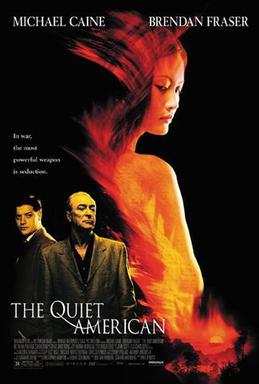
This is a poster for The Quiet American.
The poster art copyright is believed to belong to the distributor of the film, Miramax Films, the publisher of the film or the graphic artist.
The Quiet American, Graham Greene: Actor and Character
Although the message of “The Quiet American” is frequently misunderstood, Greene’s novel is a gem that predicted US involvement in Vietnam. The 2002 film version of the story is a relatively unknown masterpiece. A strong cast brings the writer’s characters to life:
Michael Caine – Thomas Fowler
Michael Caine portrays Thomas Fowler, an older English reporter stationed in Vietnam. He is covering the closing days of the French war against Communist forces in the 1950s.
Intertwined with his reporting ability, Fowler prides himself on remaining uninvolved and impartial. It is a characteristic of journalism he strives to uphold: reporting just facts with no opinion. It is also a principle of his life he struggles to maintain.
The story begins with Fowler summoned by the police for questioning. Alden Pyle, a young American member of the United States Economic Aid mission, had been murdered. Pyle and Fowler were close friends/associates but had a history over a stolen lover.
As the events unfold, Fowler remembers the first time he met Pyle, described as a quiet American. At that time, Fowler resided with his live-in lover, Phuong. However, Fowler is still married to a woman in England. Although separated, she refuses a divorce on the grounds of her religion.
After their first meeting, Fowler perceives Pyle as idealistic and naive. However, as the plot progresses, Pyle’s true intentions begin to reveal themselves. As the story unfolds, Fowler struggles with his ideal of remaining uninvolved.
Brendan Fraser – Alden Pyle
The titular Alden Pyle, played by Brendan Fraser, is a quiet American. Young and idealistic, he arrives in Vietnam as part of the United States Economic Aid mission. Fowler sees Pyle as unrealistic and naive. Regardless of his true intentions, those romantic visions lead him to trouble.
As the story progresses, we see Pyle’s protective feelings toward Phuong develop. Starting in the House of 500 Women, Alden Pyle believes it will become her future once Fowler dies and leaves her unwed. It ultimately leads to him making a play for her affection, destroying the two men’s friendship in the process.
Pyle’s idealism also involves him in more covert dealings. Alden Pyle is devoutly inspired by novelist York Harding. French forces struggle to retain their colonial hold on Vietnam against the Communists. Harding believed a “Third Force” was the actual solution.
It is hinted, although never confirmed, that Alden Pyle might have had ties to the CIA. The young American proves capable of laying the groundwork to create his version of the theoretical “Third Force.” However, Pyle’s blind idealism causes harm than good, which ultimately leads to his assassination.
Đỗ Thị Hải Yến – Phuong
Phong, portrayed by Đỗ Thị Hải Yến, is Fowler’s Vietnamese girlfriend. The young and beautiful woman knows Thomas Fowler is married and cannot marry her. Her name, the Vietnamese word for phoenix, symbolizes her resilience.
When Pyle exposes Fowler’s lie about leaving Vietnam and divorcing his wife, Phuong is forced to choose between the two men; she chooses Alden Pyle. However, following his death, she returns to Thomas Fowler.
The character of Phuong is written with little depth. She rarely portrays emotion or agency. Her older sister makes many decisions for her and acts as a guardian or stand-in parent.
Both Fowler and Pyle impose their own opinions on what Phuong wants. The cynical Fowler sees her as a lover and likes her comfort as he gets older, and the idealistic Pyle views her as a defenseless damsel in need of protection. We never learn what she wants.
However, the unknown slate of Phuong’s true desire pairs nicely with the wider theme of the end of the colonial era and the start of American involvement in Vietnam. Despite little direction from Graham Greene, actor Đỗ Thị Hải Yến fantastically portrayed the hypnotic Phuong.
Rade Šerbedžija – Vigot
One of the most underrated characters in Greene’s story is the haggard Inspector Vigot. The French detective, played by Croatian actor, Rade Šerbedžija, investigates Pyle’s death. His character draws several similarities with Fowler.
Both men are older and seasoned from their experience of life. Both hold a cynical outlook on the world yet wearily complete their jobs. Ironically, both are also unhappily married. However, where Folwer is a staunch atheist, Vigot is a devout Roman Catholic.
By the end of the story, Vigot faces a dilemma that underpins one of the novel’s major themes. Throughout Greene’s narrative, Fowler struggles with staying uninvolved and impartial. The Inspector faces a mirrored decision: thoroughly investigating Pyle’s death or letting the murder go unsolved.
If the film had been directed by Graham Greene, actor Rade Šerbedžija would have received more screen time. Vigot is a highly notable character and came across as Fowler’s foil for large sections of the novel. Despite the movie glossing over the character, Šerbedžija portrayed the character masterfully.
Lessons from The Quiet American, Graham Greene
Greene’s “The Quiet American” is a highly character-driven story. On its face, it is a tangled love story between a weary soul, an idealistic youth, and a delicate beauty. In a symbolic sense, it foretold the rising tension in Vietnam and the United States’ involvement in the region.
Despite its poor performance, the 2002 version of “The Quiet American” is a faithful adaptation of the author’s novel. If the 1958 adaptation had been more true to Graham Greene, actor and plot decisions may have created less of a “proproganda” film. Characters are essential to a good story.


Leave a Reply