

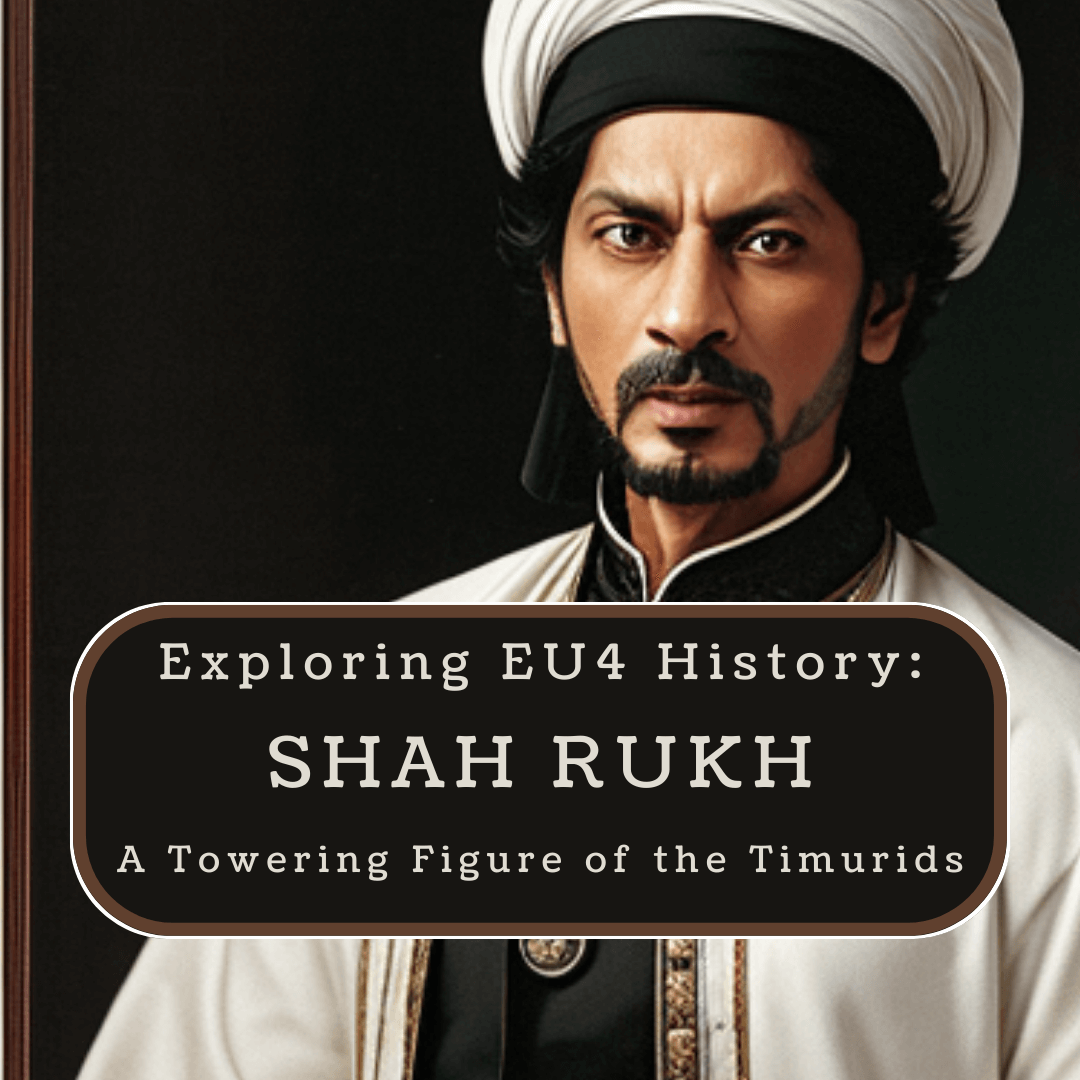
Learn about the reign of Timurid leader Shah Rukh and his influence with Exploring EU4.
Greetings, Exploring EU4 readers!
In today’s Exploring EU4 journey through the historical backdrop of Europa Universalis IV (EU4), we’ll explore the intriguing character of Shah Rukh, the ruler of the formidable Timurid Empire, in the game’s starting year, 1444.
Shah Rukh Background
Shāh Rukh Mirza, who led the Timurid Empire from 1405 until 1447, was the fourth son of the influential Timur (Tamerlane). Unlike his father’s reign, defined by conquests across Central Asia and the Middle East, Shah Rukh’s rule was noted for his adept administrative skills, diplomatic expertise, and patronage of the arts and sciences. This period under his rule ignited the era known as the Timurid Renaissance.
The Timurid Renaissance
The Timurid Renaissance was a period of intense cultural, artistic, and intellectual activity within the Timurid Empire. This era, largely initiated and fostered by Shah Rukh’s patronage, blended Persian and Turkic traditions, creating a unique cultural identity.
The Renaissance spanned various fields:
Arts and Architecture: Shah Rukh’s reign saw a surge in architectural projects, many of which became symbols of the Timurid Renaissance. Cities like Herat and Samarkand were adorned with grand mosques, madrasas, and palaces, characterized by intricate designs and vivid colors.
Literature and Philosophy: The Timurid court became a sanctuary for poets, philosophers, and scholars. Works from this period, often created under royal patronage, left an indelible mark on Persian and Turkic literature.
Science and Education: Shah Rukh’s support for education led to the flourishing of scientific inquiry. Several libraries and madrasas were established, supporting scholars who made significant contributions to the fields of astronomy, mathematics, and medicine.
Capital Move and Cultural Patronage
Shah Rukh relocated the empire’s capital from Samarkand to Herat. More than a geographical shift, this move marked a transition from an empire built on conquest to one focusing on culture and intellectual growth.
Peaceful Rule and Economic Growth
Under Shah Rukh, the empire experienced an era of relative peace, ushering in economic and social prosperity. He implemented various reforms, notably in tax collection and laws favoring trade and commerce.

The Impact of Shah Rukh’s Death
Shah Rukh’s death in 1447 marked the end of an era of relative stability and prosperity in the Timurid Empire. His demise led to a significant power vacuum, setting the stage for a period of tumultuous upheaval and conflict, forever altering the trajectory of the empire.
Succession Crisis
The immediate impact of Shah Rukh’s death was a severe succession crisis. Unlike his father, Timur, who had explicitly nominated Shah Rukh as his successor, Shah Rukh did not leave a clear line of succession. This ambiguity triggered a struggle among his many sons and grandsons, each vying for control over different parts of the empire.
Fragmentation of the Empire
The struggle for power led to the fragmentation of the Timurid Empire. Rival factions waged war against each other, weakening the central authority and allowing for the rise of independent regional powers. Territories were split among various princes, leading to the establishment of several independent Timurid states.
External Threats
Externally, the death of Shah Rukh opened up the empire to threats from aggressive neighbors. The lack of a strong central authority made the empire a target for invasions, and its territories were gradually chipped away by opportunistic neighbors.
End of the Timurid Renaissance
Shah Rukh’s death also marked the beginning of the end of the Timurid Renaissance. The cultural and intellectual flowering that had marked his reign started to fade amid the political turmoil and conflict. The grandeur of the Timurid court and its cultural institutions began to decline, and the focus shifted from patronage of arts and sciences to survival and defense.
Shah Rukh in EU4
In EU4, Shah Rukh is portrayed as the ruler of the Timurids, who exemplifies his real-life counterpart’s historical strengths. He has an impressive stat line of 4 Administrative, 3 Diplomatic, and 5 Military power, mirroring his historical persona as a skilled administrator, diplomat, and capable military strategist.
Despite his strong rule, his empire is depicted as unstable, teeming with rebellious vassal states. The only reason it remains in check at the 1444 start of EU4 is a ruler modifier unique to Shah Rukh that provides −50% liberty desire in subjects. However, even with this massive buff, Timurid subjects are barely loyal.

Shah Rukh’s Death and the Succession Crisis
Shah Rukh’s death led to a severe succession crisis. This is represented in EU4 when he dies, and the Timurid nation loses Shah Rukh’s −50% liberty desire buff. Players are faced with the daunting task of reigning in these ambitious and disloyal vassals, mirroring the historical upheaval that eventually fragmented the Timurid Empire.
The ‘True Heir of Timur’ Achievement in EU4
The ‘True Heir of Timur‘ achievement requires the player, starting as a Timurid subject, to own or have a subject own the entire region of India by 1550. This achievement effectively gives players a window of just over 100 years from the game’s start date to conquer one of the largest and richest regions in the game.
Why It’s Challenging
Several factors make this achievement particularly challenging:
Time Constraint: The requirement to control all of India by 1550 is a significant challenge, requiring swift military expansion and effective management of newly conquered territories.
Powerful Neighbors: India is surrounded by powerful nations, making a quick and unchecked expansion into the region difficult.
Internal Stability: Managing the internal stability of your realm while undergoing rapid expansion can be a tricky balancing act, with issues like overextension, rebellions, and financial constraints posing constant challenges.
Tips for Success
Here are a few general tips to conquer this achievement:
Independence and Alliances: Build strong alliances to secure your independence and maintain the vacuum created in the area when the Timurids collapse.
Early Expansion: Aim for swift and decisive victories early in the game to establish a strong base and secure areas of interest.
Effective Administration: Manage your administration effectively. This includes maintaining stability, managing overextension, and integrating new territories smoothly into your empire. This is a lot of territory to conquer in a short amount of time.
The ‘True Heir of Timur’ achievement offers a monumental challenge for EU4 players. It mirrors the historical ambition of Timurid rulers to control the rich lands of India, providing an exciting and challenging goal for players who want to test their strategic skills. Achieving it not only demands military prowess but also effective diplomacy and administrative efficiency.
Reliable Thoughts
While not as renowned as his father, Timur, Shah Rukh is a pivotal figure in EU4’s historical narrative. His reign offers a robust start for the Timurids in 1444, but his death brings challenges that can test even seasoned EU4 players.
However, while the real-life Timurid Empire fractured and fell apart, EU4 players have a chance to rewrite history and keep the historical legacy of Shah Rukh alive. If a player manages the Timurid Succession Crisis successfully, they are the strongest candidate to form the Mughals.
During your next play as the Timurids, think about Shah Rukh’s historical legacy. Until our next history lesson, happy conquering!


Leave a Reply