

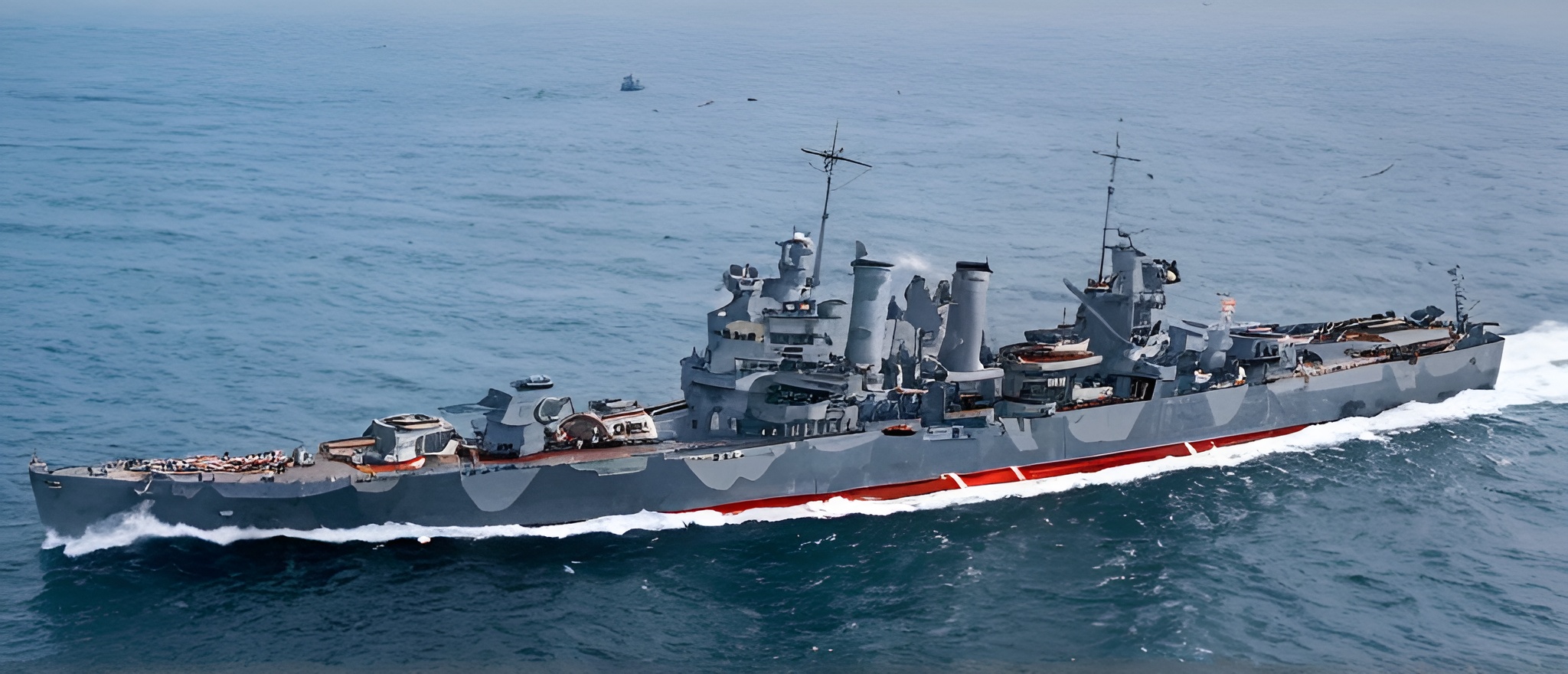
Born from treaty restrictions and rising global tension, Brooklyn-class cruisers helped reshape cruiser design for decades.
In the tense years between the two world wars, the US Navy faced a challenge: how to outgun its rivals without breaking the rules of the 1930 London Naval Treaty. The answer arrived with the Brooklyn-class light cruisers. Commissioned between 1937 and 1939, these nine warships carried more main battery guns than any American cruiser before them, packing fifteen 6-inch guns across five triple turrets.
Built within treaty limits, the Brooklyn class was a statement. These cruisers served in both the Pacific and Atlantic during World War II, with ships like Helena paying the ultimate price in combat. The class’s innovative layout and balanced design had a far-reaching influence, laying the groundwork for the Cleveland and Baltimore classes that followed.
This chapter in naval evolution isn’t just a story about ships—it’s about strategy, adaptation, and America’s march toward maritime dominance. This is the story of the Brookyln-class cruisers.
Design of the Brooklyn-Class Cruisers
Brooklyn-class cruisers were born from diplomacy. In the wake of the 1930 London Naval Treaty—which restricted the number and displacement of heavy cruisers—the United States sought a new light cruiser that could carry heavy firepower within strict limitations. While Great Britain favored smaller, affordable cruisers for imperial patrols, the US needed larger ships capable of operating across the Pacific.
Admiral William V. Pratt pushed the design despite resistance from the General Board, securing a class of cruisers that would both comply with treaty rules and meet strategic demands. Under the treaty, the United States was allowed 143,500 tons for light cruisers without a limit on the number of ships. This opened the door for a powerful fleet of 10,000-ton cruisers mounting 6-inch guns—specifically tailored for long-range operations and fleet support.
Plot Points
Hull and Machinery
Design work began in 1930, with the first four ships ordered in 1933. The class featured better armor and improved survivability than previous cruisers layouts. To match the Japanese Mogami-class—armed with fifteen 6-inch guns—the Brooklyn design also carried fifteen 6-inch guns in five triple turrets. Designers faced a delicate balancing act, experimenting with armor layouts and propulsion systems to stay under the 10,000-ton limit while preserving speed, range, and protection.
One key change was relocating aviation facilities from amidships to the stern, freeing up internal space and improving aircraft operations. As radar and air threats became more prominent, bridge structures were lowered and electronic systems added, particularly after 1942.
The St. Louis Subclass
The final two ships—St. Louis and Helena—formed a distinct subclass with notable upgrades. These ships introduced high-pressure boilers and a “unit machinery” layout, alternating boiler and engine rooms to enhance survivability. This innovation became standard in future US cruiser classes. They also featured better anti-aircraft protection and were the first American cruisers to mount twin 5-inch/38 caliber dual-purpose guns. Their updated deckhouses and weapon mounts gave them a recognizable profile distinct from earlier Brooklyn-class ships.


Main Armament
Brooklyn-class cruisers were designed to outgun any comparable foreign cruiser. Their main battery featured fifteen 6-inch/47 caliber Mark 16 guns, arranged in five triple turrets. With each gun capable of firing ten rounds per minute, a Brooklyn-class cruiser could deliver a staggering 150 shells per minute—ideal for overwhelming enemy targets.
The Mark 16 guns fired semi-fixed 130-pound armor-piercing shells over 26,000 yards, giving Brooklyn-class ships serious striking power for their size. This high rate of powerful fire changed US naval doctrine, reinforcing the value of well-armed light cruisers.
Anti-Aircraft Armament
Initially, the Brooklyn class carried eight 5-inch/25 caliber guns and eight .50-caliber machine guns. The Navy also intended to equip them with 1.1-inch (28 mm) anti-aircraft guns, but delays and mechanical problems hindered this plan. Some ships later received more capable 5-inch/38 caliber guns as well as mixes of 20 mm Oerlikon and 40 mm Bofors cannons during WWII. The most common wartime AA layout included twenty 20 mm and twenty-eight 40 mm guns—providing a strong defense against aircraft in increasingly hostile skies.
Fire Control and Radar
To make the most of their firepower, Brooklyn-class cruisers were equipped with cutting-edge fire control systems. The primary battery used the Mark 34 director, upgraded with successive radar systems: 3, then 8, and later Mark 13. Secondary batteries relied on the Mark 28 and Mark 33 fire control systems.
Each ship included two AA fire directors and later retrofits introduced the Mk 51 for Bofors control. By 1945, the addition of the Mark 57 and 63 directors improved night-fighting capability—vital for late-war Pacific engagements.
World War II Service
Brooklyn-class cruisers saw extensive combat during World War II, serving in both the Atlantic and Pacific theaters. Their versatility made them valuable in nearly every major naval campaign, from escort duties and shore bombardment to fleet engagements and amphibious assaults. While most survived the war, several ships endured heavy damage, and one—USS Helena—was lost in action.
Close Calls and Heavy Damage
On October 11, 1942, during the Battle of Cape Esperance, USS Boise was struck by enemy fire that penetrated her hull and reached a forward magazine. Fortunately, prior damage had partially flooded the compartment, preventing a catastrophic explosion. The blast killed and wounded many sailors, but the ship survived, earning the nickname “The Ship That Wouldn’t Sink.”
USS Nashville faced tragedy during the Philippines campaign. On December 13, 1944, a Japanese kamikaze plane slammed into the ship off Mindoro, igniting a fire that killed or wounded 310 crew members. Despite the carnage, Nashville remained afloat and was eventually repaired.
USS Honolulu and USS St. Louis were both torpedoed during the night Battle of Kolombangara on July 12–13, 1943. Honolulu later returned to action but was torpedoed again during the Leyte invasion on October 20, 1944.
USS Savannah was struck by a German Fritz X guided bomb off Salerno on September 11, 1943. The bomb penetrated turret #3 and detonated inside the hull, nearly breaking the ship in two. Quick action by the crew prevented sinking. She underwent extensive repairs and upgrades, including hull bulges and updated dual-purpose guns, though she did not return to frontline service before the war ended.

The Loss of USS Helena
USS Helena was the only Brooklyn-class cruiser lost in combat. She was sunk on July 6, 1943, during the Battle of Kula Gulf after taking multiple torpedo hits from Japanese destroyers. Despite heroic efforts to save the ship, she broke apart and sank. Many of her crew were rescued in the days that followed.
Ships of the Brooklyn Class
| Ship Name | Hull No. | Builder | Commissioned | Decommissioned | Fate |
| Brooklyn | CL-40 | Brooklyn Navy Yard | 30 Sep 1937 | 3 Jan 1947 | To Chile as O’Higgins (1951); sank under tow (1992) |
| Philadelphia | CL-41 | Philadelphia Naval Shipyard | 23 Sep 1937 | 3 Feb 1947 | To Brazil as Barroso (1951); scrapped (1974) |
| Savannah | CL-42 | New York Shipbuilding, Camden | 10 Mar 1938 | 3 Feb 1947 | Sold for scrap (1960) |
| Nashville | CL-43 | New York Shipbuilding | 6 Jun 1938 | 24 Jun 1946 | To Chile as Capitán Prat (1951); scrapped (1983) |
| Phoenix | CL-46 | New York Shipbuilding | 3 Oct 1938 | 3 Jul 1946 | To Argentina (1951); renamed ARA General Belgrano; sunk (1982) |
| Boise | CL-47 | Newport News Shipbuilding | 12 Aug 1938 | 1 Jul 1946 | To Argentina as Nueve de Julio (1951); scrapped (1983) |
| Honolulu | CL-48 | Brooklyn Navy Yard | 15 Jun 1938 | 3 Feb 1947 | Scrapped (1959) |
| St. Louis | CL-49 | Newport News Shipbuilding | 19 May 1939 | 20 Jun 1946 | To Brazil as Tamandaré (1951); sank under tow (1980) |
| Helena | CL-50 | Brooklyn Navy Yard | 18 Sep 1939 | — | Sunk in Battle of Kula Gulf (6 Jul 1943) |
Legacy of the Brooklyn-Class
Brooklyn-class cruisers left a lasting impact on American naval design. As the first US light cruisers to mount five triple 6-inch turrets, they balanced firepower, speed, and versatility—qualities that defined cruiser development for the rest of World War II. Their design directly influenced nearly every major cruiser class that followed.
The Cleveland-class—America’s most-produced light cruiser—used a refined Brooklyn hull, sacrificing one turret for better anti-aircraft defenses. That evolution continued into the Fargo and Worcester classes.
Meanwhile, the USS Wichita, a one-off heavy cruiser built on a modified Brooklyn hull, led to the powerful Baltimore and Des Moines-class heavy cruisers. Even the Atlanta-class shared Brooklyn-inspired engineering, though in a more compact, anti-aircraft-focused platform.
The influence didn’t stop at cruisers. As naval warfare shifted toward air power, both Cleveland and Baltimore-class hulls were adapted into light aircraft carriers—the Independence and Saipan classes.
Though only nine ships were built, the Brooklyn class became the backbone of American cruiser innovation. They served with distinction, absorbed punishment, and helped shape the future of naval architecture.


Leave a Reply